Pine Script® インジケーター
Money

Smart Money Engine [WillyAlgoTrader]Smart Money Engine (SME) is a comprehensive overlay indicator that automates the core elements of Smart Money Concepts (SMC) analysis: multi-layer market structure detection (BOS / CHoCH), order block identification with strength grading, fair value gap tracking with fill monitoring, inverse FVG generation, and auto-anchored Fibonacci retracement — all in a single, unified tool.
Rather than stacking five separate indicators on your chart — one for structure, one for OBs, one for FVGs, one for IFVGs, and one for Fibonacci — SME integrates these components so they share a common structural context. Order blocks are created at actual structure break points, FVGs are filtered against volatility, IFVGs are born from filled FVGs, and the Fibonacci grid automatically anchors to the current strong high and strong low. Every component is aware of the others, producing a cleaner and more logically consistent chart than layering independent tools.
🔍 WHAT MAKES IT ORIGINAL
1. Dual-layer structure detection (Swing + Internal). The indicator runs two independent pivot-based structure engines simultaneously. The Swing layer (configurable length, default 10) captures major market structure — the higher-timeframe trend. The Internal layer (shorter length, default 5) captures minor structure shifts within the swing trend. Both label BOS (Break of Structure — continuation) and CHoCH (Change of Character — reversal) independently. This dual-layer approach lets you see whether an internal CHoCH is happening against or with the swing trend — a key distinction in SMC methodology that single-layer tools miss.
2. Order Blocks with contextual grading (A / B / C). OBs are not placed at arbitrary candles. They are created only when a swing-level BOS or CHoCH occurs — the script walks back from the break to find the last opposite-colored candle (the institutional candle that initiated the move). Each OB is then graded:
— Grade A : OB overlaps with an FVG and has a volume spike (highest confluence)
— Grade B : OB has one confluence factor (volume spike OR FVG overlap)
— Grade C : basic OB without additional confluence
Grading helps you prioritize which zones to trade from. OBs extend until mitigated (user choice: close-based or wick-based mitigation), and each OB displays a Consequent Encroachment (CE) midline — the 50% level that often acts as the reaction point within the block.
3. Fair Value Gaps with ATR auto-filter and fill tracking. FVGs are detected using the classic three-candle gap method (current low > high two bars ago for bullish, inverse for bearish). A built-in ATR filter (enabled by default) suppresses FVGs smaller than 0.5× ATR, removing the micro-gaps that clutter charts on lower timeframes. Each FVG extends until fully filled, displays a CE midline, and is automatically removed once price closes through the gap.
4. Inverse FVG (IFVG) generation. When an FVG is fully filled by price, it doesn't just disappear — it transforms into an Inverse FVG with flipped bias. A filled bullish FVG becomes a bearish IFVG (potential resistance); a filled bearish FVG becomes a bullish IFVG (potential support). This captures the SMC concept that once institutional imbalance is filled, the zone can flip polarity. IFVGs are displayed with distinct dashed borders and tracked until mitigated by a close through their zone.
5. Auto-anchored Fibonacci retracement. The Fibonacci grid automatically spans from the current Strong High to Strong Low — the trailing extremes of the active swing structure. When a new BOS/CHoCH shifts the structure, the anchor points update and the grid repositions. The OTE (Optimal Trade Entry) zone between 0.5 and 0.618 is highlighted, giving you an immediate visual reference for the premium/discount equilibrium.
6. Strong / Weak High and Low levels. After each structural break, the indicator identifies the trailing high and low as either "Strong" or "Weak" based on their position relative to the current trend direction. In a bullish swing, the low that initiated the trend is the Strong Low (protected) and the high is the Weak High (target). These levels are extended forward as dashed lines, providing clear reference for where the trend is protected and where it is vulnerable.
⚙️ HOW IT WORKS
Structure detection:
Swing pivots are identified using ta.pivothigh() and ta.pivotlow() with the configured lookback length. The script maintains the most recent swing high and swing low. When price closes above the previous swing high (confirmed bar close, no mid-bar signals), it registers a bullish break. If the prior trend was bearish, this is labeled CHoCH (reversal); if bullish, it is labeled BOS (continuation). The same logic applies in reverse for bearish breaks. Internal structure uses an identical algorithm with a shorter lookback, and its labels are drawn with dashed lines and lighter opacity to visually distinguish them from swing-level events.
Order Block detection:
When a swing-level break is confirmed, the script scans backward (up to 30 bars) from the pivot that was broken to find the last candle with opposite polarity — the candle whose body direction opposes the break direction. The full range (high to low) of that candle becomes the OB zone. A volume spike check (volume > 1.5× 20-period SMA) adds confluence for grading. OBs extend right until the mitigation condition is met.
FVG detection:
On every confirmed bar, the script checks whether the current bar's low exceeds the high of two bars ago (bullish FVG) or the current high is below the low of two bars ago (bearish FVG). If the gap size passes the ATR filter, an FVG box is created. The box extends right each bar. If price fills the gap completely (low touches the bottom of a bullish FVG, or high touches the top of a bearish FVG), the FVG is removed and — if IFVG mode is enabled — queued for conversion to an Inverse FVG.
HTF trend filter:
An optional higher-timeframe EMA(50) filter provides directional bias. The HTF data is fetched using request.security() with confirmed-bar referencing ( + lookahead_on pattern) to prevent repainting. When enabled, the dashboard displays the HTF bias, and the confluence can factor into OB grading.
Anti-repaint compliance:
All structure breaks, OB creation, and FVG detection require barstate.isconfirmed — signals fire only after the bar closes. The HTF filter uses the standard non-repainting security call pattern. No future data is accessed.
📖 HOW TO USE
Reading the chart:
— HH / HL / LH / LL labels at swing points classify the market structure
— Solid horizontal lines with BOS or CHoCH labels = swing-level structure breaks
— Dashed lines with BOS/CHoCH = internal (minor) structure breaks
— Colored boxes = Order Blocks (green-tinted = bullish, red-tinted = bearish)
— Letter labels (A/B/C) on OBs = strength grade
— Dotted midline inside OBs = Consequent Encroachment (CE)
— Blue-tinted boxes = bullish FVGs; orange-tinted = bearish FVGs
— Dashed-border boxes labeled IFVG = Inverse Fair Value Gaps
— Dotted horizontal Fibonacci lines with OTE zone highlight = auto retracement grid
— Dashed trailing lines labeled "Strong High/Low" or "Weak High/Low" = structural extremes
Suggested workflow:
— Identify the swing trend direction from BOS/CHoCH labels and Strong/Weak levels
— Check if internal structure aligns with or diverges from swing structure
— Look for entry opportunities at Order Blocks (prioritize Grade A/B) within the Fibonacci OTE zone
— Use FVGs as additional confluence — a bullish OB that overlaps a bullish FVG is a higher-probability zone
— Monitor IFVGs for polarity-flipped zones that may act as new support/resistance
— Use the dashboard to track active OB/FVG/IFVG counts and HTF bias alignment
Timeframe guidance:
— Scalping (1–5min): Swing Length 5–7, Internal 3, increase Max OBs/FVGs for more zones
— Intraday (15min–1H): Swing Length 8–12, Internal 5, default settings work well
— Swing (4H–Daily): Swing Length 15–25, Internal 7–10, reduce Max OBs to keep chart clean
— Use the HTF filter with 1 step up (e.g. 1H chart → 4H HTF, 4H chart → D HTF)
⚙️ KEY SETTINGS REFERENCE
— Swing Detection Length (default 10): lookback for major structure pivots
— Internal Structure Length (default 5): lookback for minor structure pivots (should be < Swing Length)
— OB Mitigation (default Wick): "Close" = OB removed on close through zone; "Wick" = removed on any touch
— Show OB Grade (default On): display A/B/C strength classification on OBs
— Show OB Midline (default On): display CE (50%) line inside order blocks
— Auto-Filter Small FVGs (default On): suppress FVGs smaller than 0.5× ATR
— Max Visible OBs / FVGs / IFVGs (default 5 each): cap on displayed zones to manage chart clutter
— Show Inverse FVGs (default Off): enable IFVG generation from filled FVGs
— Show Fibonacci Retracement (default On): auto-anchored grid with OTE zone highlight
— HTF Trend Filter (default Off): set a higher timeframe for directional bias via EMA(50)
— Volume Confirmation (default On): add confluence when volume > 1.5× average (auto-disabled on forex)
📊 Dashboard
The info panel (adjustable to any chart corner) displays in real time:
— Swing trend direction (Bullish / Bearish)
— Internal trend direction
— Fibonacci range (Strong High — Strong Low)
— Count of active OBs, FVGs, and IFVGs
— HTF bias (if enabled)
— Current timeframe and indicator version
⚠️ IMPORTANT NOTES
— This indicator does not repaint. All signals and zone creations require bar-close confirmation. The HTF filter uses the standard + lookahead_on non-repainting pattern.
— SME is a structural analysis and zone-mapping tool — it identifies where institutional activity likely occurred, but it does not generate explicit buy/sell signals. Trade decisions should incorporate your own entry triggers, risk management, and additional confluence.
— Past structure patterns and zone reactions do not guarantee future price behavior.
— Performance may vary across instruments and timeframes. Lower timeframes produce more zones and structure shifts; use the ATR filter and Max Visible caps to manage noise.
— The indicator works across all asset classes. Volume-based features (OB grading) are automatically adjusted on instruments without volume data.
Pine Script® インジケーター

Adaptive Pivot Structure [WillyAlgoTrader]Adaptive Pivot Structure (APS) is an overlay indicator that maps market structure in real time by detecting swing pivots, classifying structural breaks (BOS / CHoCH), tracking missed reversal levels, and projecting a dynamic Fibonacci grid between the last confirmed pivot and the live forming extreme.
Most pivot-based tools plot swing points with a fixed delay and leave the trader to interpret structure manually. APS automates the full workflow: it detects pivots, grades their strength against ATR, identifies whether the structure is continuing (BOS) or reversing (CHoCH), keeps track of levels that price skipped over, and stretches a Fibonacci retracement grid that updates bar-by-bar as the current swing extends — giving you an always-current picture of where price sits within the swing.
🔍 WHAT MAKES IT ORIGINAL
APS combines five analytical layers into a single coherent overlay that would otherwise require multiple separate indicators:
1. ATR-graded pivot detection. Every swing high and low is measured against the current ATR to classify it as Strong (swing > 1.5× ATR) or Weak. You can filter the display to show only strong pivots, only weak ones, or all — allowing you to strip noise on lower timeframes while keeping full detail on higher ones.
2. Automated BOS / CHoCH classification. The indicator continuously compares each new pivot high to the previous pivot high, and each new pivot low to the previous pivot low. When a higher high forms in an existing uptrend, the script labels it as a Break of Structure (BOS ↑) — trend continuation. When a higher high forms after a downtrend, it labels a Change of Character (CHoCH ↑) — potential reversal. The same logic applies in reverse for bearish breaks. This removes the subjectivity of manually drawing and labeling structure shifts.
3. Missed reversal tracking. When two consecutive pivots form on the same side (e.g. two pivot highs without an intervening pivot low), the "missed" pivot low between them is flagged with a ◇ marker and extended as a dotted horizontal level until price breaks it. These missed levels often act as hidden support/resistance that conventional pivot tools ignore entirely.
4. Live (potential) pivot tracking. Instead of waiting for full confirmation (which inherently lags by N bars), APS tracks the running extreme since the last confirmed pivot and plots it in real time as a "potential next pivot" with a dashed zigzag extension. This gives you immediate visual feedback on how far the current swing has traveled and where the Fibonacci grid is anchored — without pretending the pivot is confirmed.
5. Dynamic Fibonacci grid. A full Fibonacci retracement (0, 0.236, 0.382, 0.5, 0.618, 0.786, 1.0 — with optional 1.272 and 1.618 extensions) is drawn between the last confirmed pivot and the live pivot. The grid redraws every bar as the live extreme moves, so the retracement levels always reflect the current swing range. The OTE (Optimal Trade Entry) zones at 0.236–0.382 and 0.618–0.786 are highlighted with a fill to make them easy to spot at a glance.
⚙️ HOW IT WORKS
Pivot detection:
Pivots are identified using ta.pivothigh() and ta.pivotlow() with a user-defined lookback (Pivot Length). A pivot high is confirmed when the bar has N lower highs on both sides; a pivot low when the bar has N higher lows on both sides. This means confirmed pivots appear with a delay of N bars — this is inherent to the standard pivot detection algorithm.
Strength grading:
Once a pivot is detected, the script measures the absolute price distance from the previous pivot to the current one. If this distance exceeds 1.5× the current ATR value, the pivot is classified as "Strong"; otherwise "Weak." A minimum swing size filter (Min Swing Size, expressed as an ATR multiple) lets you suppress insignificant swings entirely.
Structure logic:
The indicator maintains a running structure direction variable. When a new pivot high exceeds the previous pivot high and the current structure is already bullish, it triggers a BOS ↑. If the structure was bearish, it triggers a CHoCH ↑ (reversal). Mirror logic applies for lows. This follows standard Smart Money Concepts methodology.
Missed pivot logic:
Between any two consecutive same-side pivots, the indicator records the highest high or lowest low that occurred in the gap. This "missed" extreme is marked and extended as a horizontal level. The level is automatically removed from the chart when price closes through it — keeping only active levels visible.
Live pivot:
After each confirmed pivot, the script starts tracking the running high (if expecting a pivot high next) or running low (if expecting a pivot low). This value updates every bar and serves as one anchor of the Fibonacci grid. A "▲?" or "▼?" label and a dashed line show where this potential pivot currently sits.
Fibonacci grid:
The retracement is calculated between the lower and upper anchor of the current swing (using the confirmed pivot on one side and the live extreme on the other). All seven standard ratios are drawn as horizontal lines from the earlier pivot's bar index to 5 bars into the future. The 0.5 and 0.618 levels are drawn thicker and in a highlight color for emphasis.
⚠️ REPAINTING BEHAVIOR — IMPORTANT
This indicator is designed as a live analysis tool , not a backtesting signal generator. The following elements will change on the current bar:
— The Live Pivot marker moves as the running extreme updates
— The Fibonacci grid redraws as the live anchor moves
— BOS/CHoCH labels based on pivots inherit the standard pivot detection delay
Confirmed pivots themselves do not repaint — once a bar is no longer within the pivot lookback window, its pivot status is final. The alert system includes a "Confirmed Only" toggle (on by default) that restricts alerts to bar-close events, ensuring no repainting alerts reach your trading bot.
📖 HOW TO USE
Reading the chart:
— ▲ / ▽ labels at swing lows = confirmed pivot lows (filled = Strong, outline = Weak)
— ▼ / △ labels at swing highs = confirmed pivot highs (filled = Strong, outline = Weak)
— ◇ markers = missed reversals (cyan for missed lows, orange for missed highs)
— Dotted horizontal lines from ◇ markers = active missed levels (auto-removed when broken)
— "BOS ↑/↓" yellow labels = Break of Structure (trend continuation)
— "CHoCH ↑/↓" green/red labels = Change of Character (potential reversal)
— Purple dashed line with "▲?" or "▼?" = live potential pivot (updates every bar)
— Fibonacci lines with OTE zone fills = dynamic retracement grid
Suggested workflow:
— Use CHoCH labels as early warning of trend reversals — then look for entries in the Fibonacci discount/premium zones
— Use BOS labels to confirm trend continuation — look for pullback entries at 0.618–0.786 retracement
— Watch the dashboard's "Fib Zone" readout: Discount (below 38.2%) favors buys, Premium (above 61.8%) favors sells, Equilibrium suggests waiting
— Missed reversal levels act as hidden S/R — watch for reactions when price revisits them
Timeframe guidance:
— Scalping (1–5min): Pivot Length 3–5, Min Swing 0.5 ATR, Strong Only filter
— Intraday (15min–1H): Pivot Length 5–10, default settings
— Swing (4H–Daily): Pivot Length 10–20, show all strengths for full context
⚙️ KEY SETTINGS REFERENCE
— Pivot Length (default 5): bars left/right for pivot detection — lower = faster but noisier
— ATR Length (default 14): period for strength grading and minimum swing filter
— Min Swing Size (default 0.0): minimum swing as ATR multiple — increase to filter small moves
— Pivot Strength Filter (default All): show All / Strong Only / Weak Only
— Max Active Levels (default 10): maximum missed-reversal horizontal lines displayed
— Show Live Pivot (default On): toggle the real-time potential pivot tracker
— Show Fibonacci Grid (default On): toggle the dynamic retracement overlay
— Show Extensions (default Off): add 1.272 and 1.618 extension levels
— Show Fib Zone Fill (default On): highlight OTE zones (0.236–0.382 and 0.618–0.786)
— Alerts: Confirmed Only (default On): restrict alerts to bar-close confirmation — recommended for bots
📊 Dashboard
The info panel (adjustable to any chart corner) displays:
— Current market structure (Bullish / Bearish / Ranging)
— Last confirmed pivot type and price
— Live pivot direction and price
— Number of active missed-reversal levels
— Last PH and PL values
— Fib Zone classification (Premium / Discount / Equilibrium) with percentage
— Current timeframe and indicator version
⚠️ DISCLAIMER
— This tool is intended for live chart analysis and structure mapping — it is not a standalone entry/exit signal system.
— The live pivot and Fibonacci grid are designed to repaint by nature — they track the forming swing in real time. Do not use them for backtesting.
— Past pivot patterns and structure shifts do not guarantee future price behavior.
— Always combine structural analysis with proper risk management and additional confluence.
Pine Script® インジケーター

Liquidity Radar# Liquidity Radar
## Overview
Liquidity Radar is a Smart Money Concepts (SMC) indicator that visualizes where institutional liquidity rests in the market. It combines automatic market structure detection (BOS & CHoCH), a thermal liquidity heatmap, dynamic order blocks, and fair value gaps into a single, performance-optimized overlay.
**Free & Open Source** — no invite-only access, no paywall. Full source code, fully transparent.
## The Concept: Why Liquidity Matters
In institutional trading, **liquidity pools** form above swing highs and below swing lows — these are clusters of stop-loss orders from retail traders. Smart money targets these pools to fill large positions. Understanding where liquidity rests gives you an edge in anticipating price movements:
- **Swing High Liquidity** — Stop-losses from short sellers sit above swing highs
- **Swing Low Liquidity** — Stop-losses from long buyers sit below swing lows
- **Liquidity Sweeps** — When price takes out a swing level to grab these stops, it often reverses
The indicator automates the detection and visualization of these key levels.
## Core Features
### 1. Thermal Liquidity Heatmap
The signature feature. Liquidity zones appear at every confirmed swing high and swing low with a thermal color gradient:
- **Fresh zones** — Warm colors (orange/yellow) indicate high relevance
- **Aging zones** — Cool colors (purple/blue) indicate decreasing relevance as time passes
- **Volume-weighted intensity** — Zones formed on high-volume bars appear more intense
- **Auto-cleanup** — Zones fade out over a configurable decay period and are removed when price sweeps through them
### 2. Market Structure Detection (BOS & CHoCH)
Automatic swing high/low detection using pivot-based logic:
- **BOS (Break of Structure)** — Price breaks a prior swing level in the trend direction (continuation). Shown as dashed lines.
- **CHoCH (Change of Character)** — Price breaks a prior swing level against the trend (potential reversal). Shown as solid lines with thicker width.
- Color-coded: Cyan/Teal = bullish, Magenta/Pink = bearish
### 3. Dynamic Order Blocks
Institutional supply and demand zones rendered as semi-transparent boxes:
- **Bullish OB** — The last bearish candle before a strong bullish move (at swing lows)
- **Bearish OB** — The last bullish candle before a strong bearish move (at swing highs)
- Configurable mitigation threshold — controls how much price must penetrate the block before it is considered mitigated
- Auto-removed when price closes through the block
### 4. Fair Value Gaps (FVG)
Three-candle inefficiency detection:
- Bullish FVG: Gap between candle 1's low and candle 3's high
- Bearish FVG: Gap between candle 1's high and candle 3's low
- ATR-based noise filter removes insignificant gaps
- Auto-removed when price fills the gap
- Default: OFF (toggle on in settings)
### 5. Premium / Discount Zones
Based on the current swing range:
- **Premium Zone** (upper half) — Light red background
- **Discount Zone** (lower half) — Light green background
- **Equilibrium Line** (50%) — Dashed amber line
- Default: OFF (toggle on in settings)
## Dashboard
A compact, dark-themed info panel displaying:
- **Trend** — Current market direction (Bullish / Bearish / Neutral)
- **Structure** — Last detected structure signal (BOS or CHoCH)
- **Liq. Heat** — How many liquidity zones are near the current price (High / Medium / Low)
- **Volume** — Above or below 20-period average
- **Momentum** — RSI(14) status (Overbought / Neutral / Oversold)
- **Next Zone** — Nearest liquidity zone with price level and distance in percent
## Auto-Timeframe Adaptation
All parameters automatically adjust to your chart timeframe:
| Timeframe | Swing Lookback | Heatmap Decay |
|-----------|---------------|---------------|
| 1-5 min | 6 | 100 bars |
| 15 min | 10 | 80 bars |
| 30 min | 12 | 80 bars |
| 1 Hour | 15 | 60 bars |
| 4 Hour | 22 | 50 bars |
| Daily | 35 | 40 bars |
| Weekly+ | 50 | 30 bars |
You can switch to manual mode for full control.
## Alert Types (7)
1. Bullish BOS — Break of Structure confirmed (continuation up)
2. Bearish BOS — Break of Structure confirmed (continuation down)
3. Bullish CHoCH — Change of Character detected (potential reversal up)
4. Bearish CHoCH — Change of Character detected (potential reversal down)
5. Bullish Liquidity Sweep — Swing high liquidity taken
6. Bearish Liquidity Sweep — Swing low liquidity taken
7. Price Entering Order Block — Price enters a bullish or bearish OB zone
## Settings
**Market Structure:**
- Show BOS / CHoCH (on/off)
- Auto Swing Lookback (on/off)
- Manual Swing Lookback (3-100)
- BOS / CHoCH line styles and width
**Liquidity Heatmap:**
- Show Heatmap (on/off)
- Auto Decay Period (on/off)
- Manual Decay (10-500 bars)
- Zone Width (ATR multiplier)
- Volume-Weighted Intensity (on/off)
- Max Active Zones (4-20)
**Order Blocks:**
- Show Order Blocks (on/off)
- Max OBs per Side (1-6)
- Mitigation Threshold (0.0-1.0)
**Fair Value Gaps:**
- Show FVGs (on/off, default OFF)
- Min FVG Size (ATR multiplier)
- Max Active FVGs (2-15)
- FVG Extend (bars)
**Premium / Discount:**
- Show Zones (on/off, default OFF)
- Zone Transparency
**Dashboard:**
- Show Dashboard (on/off)
- Position (Top Right / Top Left / Bottom Right / Bottom Left)
- Size (Tiny / Small / Normal)
**Visual Settings:**
- All 5 colors fully customizable
- Watermark (on/off)
## Non-Repainting
All signals are calculated on confirmed (closed) bars only. Pivot detection inherently requires N bars of confirmation on each side. BOS/CHoCH signals fire on the bar where the break occurs, after the swing point is already confirmed. What you see is what happened — no hindsight bias.
## Works On
- Crypto (BTC, ETH, SOL, ...)
- Forex (EUR/USD, GBP/JPY, ...)
- Stocks (AAPL, TSLA, NVDA, ...)
- Futures & Indices (NQ, ES, SPX, ...)
- Any timeframe from 1 minute to Monthly
## Disclaimer
This indicator is for educational and informational purposes only. It does not constitute financial advice. Always do your own research and manage your risk. Past performance does not guarantee future results. Trading involves substantial risk of loss.
Pine Script® インジケーター

Geopbytech Risk Based Lots Calculator📊 Geopbytech – Risk Based Lots Calculator
Built by Juan C. Delgado
A lightweight and fast position size calculator designed to help traders determine optimal lot size directly from the TradingView chart.
No more switching to external websites during live execution.
Simply input:
Account Size (USD)
Risk Ratio %
Stop-Loss distance (pips or points)
The tool instantly calculates the correct lot size based on proper risk management.
🔹 How It Works
The calculator determines:
Risk ($) = Account Size × Risk %
Lot Size = Risk ($) ÷ (Stop-Loss Units × $ Value per Unit per 1 Lot)
Everything updates instantly as you change values.
🔹 Example
Account Size Risk % Stop Loss Result
$10,000 1% 20 pips 0.50 lots
$5,000 1% 15 pips 0.33 lots
$8,000 2% 30 pips 0.53 lots
🔹 Default Configuration (Forex – EURUSD)
By default, the script is optimized for standard Forex pairs like EURUSD.
You only need to:
Enter Account Size
Enter Risk %
Enter Stop-Loss in pips
The script automatically calculates pip value using standard 100,000 contract size.
🔹 Trading Gold (XAUUSD)
If you are trading Gold:
Enable:
✔ Override $ per unit (non-FX)
Then adjust:
• Override $ per 1 unit per 1 lot
(or use Custom Unit Size if needed depending on broker specification)
Because gold brokers may use different contract sizes.
🔹 Trading Indices
For indices (NAS100, US30, SPX, etc.):
You can:
• Leave override OFF (if TradingView provides correct point value)
OR
• Enable Override and manually define $ value per point per lot
Depends on your broker's contract specification.
🔹 Trading Cross Pairs (GBPJPY, EURJPY, etc.)
For Forex crosses:
Leave override OFF.
If calculation warning appears:
Adjust "Custom Unit Size" to match correct pip structure.
Example:
GBPJPY may require adjusting unit size depending on feed.
🔹 Inputs Explained
Account Size (USD)
Your total trading account balance.
Risk Ratio %
Percentage of account you are willing to lose per trade.
(Example: 1% = disciplined risk management)
Stop-Loss (pips / points)
Distance from entry to stop loss.
This must match what you use in the TradingView position tool.
Custom Unit Size (price)
Advanced setting.
Used when your symbol does not follow standard pip or tick logic.
You define how much price movement equals 1 unit.
FX Contract Size
Default: 100,000 (standard lot in Forex).
Only change if your broker uses non-standard contract sizes.
🎨 UI Customization
You can customize:
• Theme (Dark / Light / Midnight)
• Dashboard Position
• Transparency
• Text Size
• Warning visibility
⚠️ Important Notes
This tool calculates position size based on TradingView symbol specifications.
Broker contract sizes may vary.
Always verify:
Pip value
Contract size
Margin requirements
Final order size
Before placing a live trade.
⚠️ Disclaimer
This tool is provided for educational and informational purposes only.
It does not constitute financial advice, investment advice, or trading recommendations.
Trading involves substantial risk and may result in loss of capital.
Use at your own risk.
👤 Author
Built by Juan C. Delgado
Geopbytech
Pine Script® インジケーター

Quantitative Momentum & Institutional Flow System🇨🇳 中文
🔍 概述
QuantFlow_MSVO 是一款专业量化指标,用于追踪机构资金流向、基准指数情绪及趋势衰竭。通过对比标的与参考指数(如上证指数)的资本动态,识别资金共振区——个股与大盘同步吸筹或派发的关键区域。
🧠 核心逻辑
机构资金流:基于加权价 (2*C+H+L)/4 * 10 构建类MACD振荡器(13/34指数平均,5期信号线),柱状图放大5.5倍,反映机构净参与力度。
基准情绪:对所选指数应用完全相同的算法,生成独立的流入/流出度量。
趋势矩阵:将收盘价在55根K线范围内标准化为0–100,经三重平滑(3×简单移动平均 → 指数平均)得到干净、不漂移的趋势线。
动能加速度:趋势线的环比变化率,用于捕捉早期突破。
🎨 视觉元素
机构资金 – 洋红(流入)/ 蓝色(流出),粗线。
基准资金 – 红色(正向)/ 绿色(负向),细线。
趋势线 – 橙色,范围0–100,辅以13(吸筹区)和90(超买区)参考线。
状态柱 –
🟠 趋势≤13时显示 蓄势脉冲 (20)
🔵 趋势≤13且加速度>13时显示 爆发确认 (50)
🔴 趋势>90且上升时显示 抛压警戒 (100)
共振柱 – 当机构流入或基准流入与趋势≤13共振时,显示洋红/红色柱 → 吸筹共振。
文字标签 – 筑底区域、买入确认、趋势衰减仅在信号首次出现时绘制,界面清爽。
📊 使用方法
底部区域(趋势≤13):寻找洋红/红色共振柱 → 潜在吸筹。蓝色爆发确认柱+标签是更强的入场信号。
顶部区域(趋势>90):橙色线走平或拐头,同时机构流入减弱,触发趋势衰减标签 → 派发预警。
零轴:机构资金流平衡线。
⚙️ 参数设置
可在属性中更换参考指数(默认上证指数)。
所有周期(13、34、5、55、8、18等)均为原始算法固化的数值,无外部输入,确保一致性与不重绘。
🌍 适用市场
主要为中国A股设计,也适用于任何机构行为显著的流动性市场。日线及以下周期效果最佳。
English
🔍 Overview
QuantFlow_MSVO is a professional quantitative indicator that tracks institutional money flow, benchmark sentiment, and trend exhaustion. By comparing the capital dynamics of the current symbol against a reference index (e.g., SSE 000001), it identifies capital resonance zones — areas where individual stocks and the broader market accumulate or distribute in sync.
🧠 Core Logic
Institutional Flow: Derived from a MACD‑style oscillator on the weighted price (2*C+H+L)/4 * 10. Uses 13/34 EMAs and a 5‑period signal line. The histogram (scaled ×5.5) represents net institutional engagement.
Benchmark Sentiment: Applies the identical algorithm to the selected index, generating independent inflow/outflow metrics.
Trend Matrix: Normalizes the close within a 55‑bar range (0–100), then applies triple smoothing (3×SMA → EMA) to produce a clean, non‑repainting trend line.
Momentum Acceleration: Period‑over‑period percentage change of the trend line detects early breakouts.
🎨 Visual Components
Institutional Flow – Fuchsia (inflow) / Blue (outflow), bold lines.
Benchmark Flow – Red (positive) / Green (negative), thin lines.
Trend Line – Orange, scale 0–100, with reference lines at 13 (accumulation zone) and 90 (overbought zone).
Status Columns –
🟠 蓄势脉冲 / Prepare Cash (20) when trend ≤ 13
🔵 爆发确认 / Breakout (50) when trend ≤ 13 and momentum accel > 13
🔴 抛压警戒 / Exhaustion (100) when trend > 90 and rising
Resonance Columns – Magenta/Red columns when institutional inflow or benchmark inflow aligns with trend ≤ 13 → accumulation resonance.
Labels – 筑底区域 / Accumulation, 买入确认 / BUY, 趋势衰减 / TOP EXIT appear only at the first occurrence to avoid clutter.
📊 Usage Guide
Bottom zone (trend ≤ 13): Look for fuchsia/red resonance columns → potential accumulation. A blue Breakout column + label is a stronger entry trigger.
Top zone (trend > 90): Orange line flattening or turning down, combined with weakening institutional inflow, generates a TOP EXIT label → distribution warning.
Zero line: Balance axis for institutional flow.
⚙️ Parameters
Reference index can be changed in the settings (default: SSE 000001).
All periods (13, 34, 5, 55, 8, 18, etc.) are hard‑coded according to the original algorithm – no user inputs, ensuring consistency and non‑repainting.
🌍 Suitable Markets
Primarily designed for Chinese A‑shares, but applicable to any liquid market where institutional activity matters. Works best on daily or lower timeframes.
Pine Script® インジケーター

StO Price Action - OrderblockShort Summary
- Displays bullish and bearish Order Blocks on the chart
- Highlights active, mitigated, and tapped Order Blocks
- Designed for structure- and price-action-based trading
Full Description
Overview
Identifies Order Blocks using pivot-based market structure
Bullish Order Blocks originate from down candles before impulsive moves up
Bearish Order Blocks originate from up candles before impulsive moves down
Order Blocks are visualized as price zones with optional fill and borders
Mitigated Order Blocks can be kept visible as historical context
Consequent Encroachment (CE) line marks the 50% level of the block
Handling
Multi-timeframe capable Order Block detection
Clear visual distinction between bullish and bearish zones
Optional highlighting when price taps an Order Block
Supports clean chart layouts with customizable colors and styles
Designed to work with discretionary and systematic approaches
Usage
Select the timeframe used for Order Block detection
Adjust pivot lookback to control sensitivity
Enable or disable historical (mitigated) Order Blocks
Use highlight-on-touch to spot active interactions
Apply filters such as minimum body size, ATR displacement or EMA trend
Notes
Order Blocks do not predict direction, they mark areas of interest
Once detected, Order Blocks remain static and do not repaint
Higher pivot lengths produce fewer but stronger Order Blocks
ATR and body-percentage filters reduce noise in ranging markets
Best combined with market structure, liquidity or entry confirmation tools
Pine Script® インジケーター

StO Price Action - Buy | Sell Side LiquidityShort Summary
- Visualizes Buy-Side and Sell-Side Liquidity levels
- Highlights resting liquidity above highs and below lows
- Designed for price-action and liquidity-based trading
Full Description
Overview
- Detects liquidity pools using pivot-based price structure
- Buy-Side Liquidity (BSL) forms above relative highs
- Sell-Side Liquidity (SSL) forms below relative lows
- Liquidity levels represent areas where stop orders are likely resting
- Levels are extended forward to visualize potential draw-on-liquidity zones
- Optional historical liquidity tracking for contextual analysis
Handling
- Focuses on price-driven liquidity rather than indicators
- Supports BSL only, SSL only or combined visualization
- Uses configurable pivot lookback to define significant swings
- Distinguishes active liquidity from historical liquidity
- Clean, minimal chart overlay with customizable styles
Usage
- Select which liquidity side to display (BSL, SSL or both)
- Adjust pivot lookback to control sensitivity
- Configure line length and extension behavior
- Enable history mode to keep older liquidity levels visible
- Use liquidity levels as targets, reaction zones or confluence areas
Notes
- Liquidity levels do not predict direction, only attraction
- Once plotted, levels remain static and do not repaint
- Higher lookback values produce fewer but stronger levels
- Best combined with market structure, entries, or rejection logic
- Particularly effective around session highs and lows
Pine Script® インジケーター

ICT Bias ProICT Bias Pro: Dashboard + First Hour Range & Session FVGs
This indicator is a comprehensive "Bias Builder" designed for traders who follow Inner Circle Trader (ICT) concepts. It combines a multi-timeframe trend dashboard with a specific intraday strategy derived from ICT's recent teaching: "How Do I Engage Markets When I Don't Have An Initial Bias?"
The tool is designed to help traders find confluence between the Macro trend (Daily/4H) and the Micro execution (15M/5M) during the New York AM Session.
Features & Methodology
1. Multi-Timeframe Bias Dashboard Located in the corner of your chart, this dashboard provides a quick "Traffic Light" view of the market structure across 4 key timeframes:
Daily & 4-Hour: Establishes the macro direction.
15-Min & 5-Min: Monitors intraday order flow.
Logic: Bias is determined by comparing price relative to the 20 EMA and checking for Market Structure alignment. Green = Bullish, Red = Bearish.
2. The "First Hour" Trading Range (No-Bias Strategy) Following ICT’s specific logic for days when bias is unclear, this tool automatically highlights the 9:30 AM – 10:30 AM (New York Time) trading range.
Range High & Low: Defining the volatility of the opening hour.
Equilibrium (50%): The "Line in the Sand." Price holding above the 50% signals bullish strength (Premium); price below signals bearish weakness (Discount).
Quadrants (25% & 75%): Deep discount/premium zones for precision entries.
3. Session-Specific Fair Value Gaps (FVG) The indicator automatically detects and draws Fair Value Gaps that form only within that critical first hour of trading.
Auto-Extension: Boxes extend to the right until price "mitigates" (fills) them.
Consequent Encroachment (C.E.): Automatically plots the 50% dashed line inside every FVG, a key institutional support/resistance level.
Smart Mitigation: Once a gap is filled, the box changes color (user-selectable) to indicate it is no longer an active magnet.
How to Use This Indicator
This tool is designed to identify Confluence:
Check the Dashboard: Look for alignment on the Daily and 4H timeframes (e.g., Both Green).
Wait for 10:30 AM EST: Allow the script to draw the First Hour Range.
Trade the Confluence:
Bullish Setup: If the Dashboard is Green, look for price to hold above the 50% Equilibrium of the First Hour Range. Look for entries inside Bullish FVGs that form near the 50% or 75% levels.
Bearish Setup: If the Dashboard is Red, look for price to reject the 50% Equilibrium and stay in the lower half. Target Bearish FVGs near the 50% or 25% levels.
Settings & Customization
Dashboard Toggle: Show or hide the table to keep charts clean.
Colors: Fully customizable colors for Range High/Low, FVGs (Bullish/Bearish), and Mitigated gaps.
Text Positioning: Adjust FVG labels (Left/Center/Right) to prevent visual clutter on candles.
Credits & Attribution
Concept: Inner Circle Trader (Michael Huddleston).
Core Strategy: Based on the video "How Do I Engage Markets When I Don't Have An Initial Bias?"
Disclaimer: This tool is for educational purposes only. Past performance is not indicative of future results.
Pine Script® インジケーター

Daily Bias Trade Manager [MarkitTick]💡 The Daily Bias Trade Manager is a sophisticated technical analysis suite designed to automate the identification of high-probability intraday setups based on liquidity concepts and structural shifts. By synthesizing Previous Day High/Low (PDH/PDL) interactions with momentum confirmation and strict risk management protocols, this tool assists traders in navigating the "Daily Bias." It moves beyond simple signal generation by offering a complete trade management visualization system, projecting entries, stop losses, and take-profit levels directly onto the chart in real-time.
✨ Originality and Utility
This script distinguishes itself by integrating institutional price action theory—specifically Liquidity Sweeps and Change in State of Delivery (CISD)—with mechanical filtering. While many indicators simply highlight highs and lows, the Daily Bias Trade Manager validates these levels by analyzing what happens *after* price tests them.
It solves a common problem for intraday traders: "Analysis Paralysis." By automating the detection of structure breaks (MSS) and Fair Value Gaps (FVG) following a sweep of daily liquidity, it provides an objective framework for entry. Furthermore, the built-in "Position Box" feature removes the guesswork from trade execution by instantly calculating risk-to-reward ratios and visualizing them, allowing traders to see the feasibility of a trade before execution.
🔬 Methodology and Concepts
The core logic operates on a sequential detection model:
Liquidity Identification: The script first plots the Previous Day High (PDH) and Previous Day Low (PDL). These are critical institutional reference points where stop-loss orders (liquidity) often reside.
The Sweep: A "Sweep" is confirmed when price breaches a PDH/PDL but fails to sustain the breakout, closing back inside the previous day's range. This suggests a "Fake-out" or liquidity grab, often a precursor to a reversal.
Change in State of Delivery (CISD): Following a sweep, the script monitors local market structure. It looks for a decisive close past a recent swing point (Swing High for shorts, Swing Low for longs) within a user-defined bar window. This confirms that the counter-trend move has momentum.
Confluence Filtering: To reduce false positives, the engine applies optional filters:
RVOL (Relative Volume): Ensures the sweep occurred on significant volume (Climax behavior).
RSI Momentum: Verifies that momentum supports the reversal direction.
Trend Filter: Uses a long-term EMA to ensure trades align with the broader market direction.
Entry Model: Upon validation, the script calculates an entry at the close (or optionally at a Fair Value Gap), places a Stop Loss at the sweep extreme, and projects three Take Profit targets based on configurable R:R ratios.
🎨 Visual Guide
The indicator uses a distinct color-coded system to keep the chart clean yet informative:
● Liquidity Levels & Sweeps
Orange/Blue Lines: Represent the PDH (Previous Day High) and PDL (Previous Day Low).
Teal Shaded Zones: Indicate a "Buy-Side Sweep" (Price took highs and rejected).
Red Shaded Zones: Indicate a "Sell-Side Sweep" (Price took lows and rejected).
● Position Management Boxes
When a signal triggers, a structured box appears:
Solid Gray Line: The theoretical Entry Price.
Solid Red Line: The Stop Loss (SL), typically placed at the swing high/low of the sweep.
Dashed Blue Lines: Represent TP1, TP2, and TP3 targets based on Reward-to-Risk settings.
Labels: Data tags on the right side of the box show exact price coordinates for Entry, SL, and Targets.
● Signals & Clouds
Green "BUY" Labels: Appear below the bar when a bullish sweep and structural shift are confirmed.
Red "SELL" Labels: Appear above the bar when a bearish sweep is validated.
Yellow Clouds: Highlight Fair Value Gaps (FVG) used for entry confluence or retests.
● Multi-Timeframe (MTF) Dashboard
A panel (default: Top Right) displays the status of up to three higher timeframes.
Trend: Shows "BULL" or "BEAR" based on EMA alignment.
Liquidity: Indicates if the timeframe is "Taking Buy Liq", "Taking Sell Liq", or "Inside Range".
📖 How to Use
● Bullish Reversal Setup
Wait for price to drop below the Blue PDL Line.
Look for a Red Sell-Side Sweep Zone to form, indicating price has rejected lower prices.
Wait for the Green BUY Signal . This confirms a shift in structure (CISD) back to the upside.
Observe the Position Box. If the Risk/Reward is favorable (targets are within reasonable reach), consider the trade.
Optional: Use the "Dynamic Targets" setting to target the previous swing high instead of a fixed ratio.
● Bearish Reversal Setup
Wait for price to rally above the Orange PDH Line.
Look for a Teal Buy-Side Sweep Zone .
Wait for the Red SELL Signal confirming the rejection.
Ensure the dashboard shows alignment (e.g., Higher Timeframe Trend is Bearish) for higher probability.
● Trade Management
Enable the "ATR Trailing Stop" in settings to have the Stop Loss line dynamically adjust as price moves in your favor, locking in potential gains.
⚙️ Inputs and Settings
● General & Display
Show Daily Liquidity: Toggles the PDH/PDL lines.
Max Signals/Zones: Limits the visual clutter by restricting historical shapes.
● Detection Logic
Swing Detection Length: Controls the sensitivity of pivot points. Higher numbers = fewer, more significant swings.
CISD Window: How many bars after a sweep are allowed for the structure shift to occur.
Use FVG Entry: If true, the signal waits for a retest of a gap rather than entering immediately at the close.
● Filters
Volume (RVOL): Requires the sweep candle volume to be X times larger than average.
Trend Filter: Only allows Buy signals above the EMA and Sell signals below it.
Session Filter: Restricts signals to specific hours (e.g., New York Killzone).
● Targets & Management
Target R:R: Sets the multiplier for TP1, TP2, TP3 relative to the stop loss distance.
Use Dynamic Targets: Targets structural liquidity (Previous Highs/Lows) instead of fixed math ratios.
ATR Trailing Stop: Activates the trailing stop mechanism.
🔍 Deconstruction of the Underlying Scientific and Academic Framework
This indicator is grounded in the principles of Market Microstructure and Mean Reversion theory .
1. Liquidity Pools & Stop Runs:
Academic literature on market microstructure suggests that order flow clusters around obvious visual references (PDH/PDL). Large market participants often utilize this "resting liquidity" to fill large block orders with minimal slippage. The "Sweep" logic detects this absorption phase.
2. Volatility Breakout vs. Fake-out:
The script differentiates between a genuine breakout and a mean-reverting "fake-out" by analyzing the Close relative to the Range . A close back within the prior day's range after a breach signifies a failure of auction in the new territory, statistically increasing the probability of a reversion to the mean (equilibrium).
3. Momentum Validation (RSI & RVOL):
By integrating Relative Volume (RVOL) and RSI, the script applies statistical significance testing to the price action. High volume at a range extreme without price progress (the sweep) indicates "Stopping Volume" or absorption, a key concept in Volume Spread Analysis (VSA).
🙏 Gratitude
I would like to express my gratitude to harry040708 for sharing the insightful idea that made this script possible.
⚠️ Disclaimer
All provided scripts and indicators are strictly for educational exploration and must not be interpreted as financial advice or a recommendation to execute trades. I expressly disclaim all liability for any financial losses or damages that may result, directly or indirectly, from the reliance on or application of these tools. Market participation carries inherent risk where past performance never guarantees future returns, leaving all investment decisions and due diligence solely at your own discretion.
Pine Script® インジケーター

Batoot Algo PureBatoot Algo (Pure Analysis Mode)
Indicator Overview
Batoot Algo is an advanced technical analysis indicator based on:
Price Action and geometric chart patterns
Higher Timeframe (HTF) trend filtering
Volume confirmation
Breakout & Retest logic
Head & Shoulders pattern detection
Analysis-only indicator. No Buy/Sell labels on the chart. Alerts and Dashboard only.
The goal is clean charts and smarter trading decisions.
---
Entry Modes
Aggressive (Breakout)
Immediate entry on breakout
Requires:
Confirmed breakout
High volume
Optional trend alignment
Conservative (Retest)
Breakout → Wait for retest → Confirmation candle
Reduces false signals
Suitable for patient trading
---
HTF Trend Filter
Uses EMA crossover on higher timeframe:
EMA 50
EMA 200
EMA50 > EMA200 → Bullish EMA50 < EMA200 → Bearish
Filter can be enabled or disabled in settings.
---
Price Patterns Detected
Automatically detects and draws:
Bullish / Bearish Flags
Channels
Triangles / Pennants
Rising Wedge (Bearish)
Falling Wedge (Bullish)
The area between support and resistance lines is dynamically filled based on the pattern.
---
Yellow Candle (High Volume)
Yellow candles indicate High Volume.
Triggered when:
Current candle volume >= Average volume of last 20 candles × volume multiplier
Default multiplier: 1.5
Confirms strong breakouts. Not a standalone entry signal.
---
Head & Shoulders Detection
Supports:
Head & Shoulders (Bearish)
Inverse Head & Shoulders (Bullish)
Neckline drawn automatically. Breakout validated with volume. Pattern status shown in Dashboard.
---
Dashboard
Displays:
Entry Mode (Aggressive / Conservative)
HTF Trend
Current Pattern
Head & Shoulders Status
Market Status: ENTRY BUY, ENTRY SELL, WAIT RETEST, SCANNING
---
Alerts
Alerts trigger only when:
Pattern confirmed
Breakout / Retest logic satisfied
High volume confirmed
Trend filter (if enabled) passes
No trade labels plotted on chart.
---
License & Attribution
Licensed under Creative Commons Attribution 4.0 (CC BY 4.0)
Free to use and modify. Attribution required. Removing or changing the author name is not allowed.
---
This indicator is for technical analysis purposes only and is not financial advice. Always use proper risk management.
---
Clean chart, smart analysis, better trading decisions.
Pine Script® インジケーター

Smart Money Structure FilterEnglish Description
Overview
Smart Money Structure Analyzer is a professional trading tool that implements Smart Money Concepts (SMC) to identify key market structure shifts, Break of Structure (BOS), and Change of Character (CHoCH) patterns. This indicator helps traders follow the "smart money" flow by detecting institutional order flow patterns on any timeframe.
Key Features
Swing Point Detection - Identifies significant highs and lows using fractal-based logic
Market Structure Analysis - Classifies market conditions as Uptrend, Downtrend, or Consolidation
Break of Structure (BOS) - Detects when price breaks key structural levels
Change of Character (CHoCH) - Identifies potential trend reversals
Mitigation Levels - Shows potential retracement targets after structure breaks
How It Works
The indicator analyzes price action through several layers:
Swing Detection Algorithm
Uses a configurable swing period (3-21 bars)
Identifies valid swing highs and lows that are confirmed by surrounding price action
Stores the last 20 swings for structure analysis
Structure Determination
Uptrend: Higher Highs (HH) + Higher Lows (HL)
Downtrend: Lower Lows (LL) + Lower Highs (LH)
Consolidation: Mixed structure or ranging market
Break of Structure (BOS) Logic
Bearish BOS: Price closes below the last confirmed Higher Low (HL)
Bullish BOS: Price closes above the last confirmed Lower High (LH)
Change of Character (CHoCH) Logic
Bearish CHoCH: After a bearish BOS, price forms a Lower Low (confirms trend reversal)
Bullish CHoCH: After a bullish BOS, price forms a Higher High (confirms trend reversal)
Mitigation Levels
Calculates potential retracement levels after BOS (typically ±0.2% from broken structure)
Visual Elements
Fractals: Swing points (optional display)
Structure Lines: Last Higher Low (blue) and Last Lower High (purple)
BOS Signals: Triangles marking structure breaks
CHoCH Signals: Circles confirming trend changes
Mitigation Levels: Dotted orange lines for potential retracements
Info Label: Real-time structure status and key levels
Alerts
The indicator provides alerts for:
Break of Structure (BOS) events
Change of Character (CHoCH) confirmations
Settings
Swing Period: Sensitivity of swing detection (default: 3)
Show Fractals: Toggle swing point markers
Show Structure Lines: Display key structure levels
Show Break of Structure: Display BOS signals
Show Change of Character: Display CHoCH signals
Show Mitigation Levels: Display retracement levels
Best Practices
Use on higher timeframes (1H+) for more reliable signals
Combine with volume analysis for confirmation
Wait for CHoCH confirmation before entering trades
Use mitigation levels as potential entry zones
Русское описание
Обзор
Smart Money Structure Analyzer - профессиональный торговый инструмент, реализующий концепции Smart Money (SMC) для определения ключевых сдвигов рыночной структуры, Break of Structure (BOS) и Change of Character (CHoCH). Индикатор помогает отслеживать поток "умных денег", выявляя паттерны институционального ордерного потока на любом таймфрейме.
Ключевые возможности
Определение свингов - Выявляет значимые максимумы и минимумы с помощью фрактальной логики
Анализ структуры рынка - Классифицирует состояние рынка: Восходящий тренд, Нисходящий тренд или Консолидация
Break of Structure (BOS) - Обнаружение пробития ключевых уровней структуры
Change of Character (CHoCH) - Определение потенциальных разворотов тренда
Уровни митигации - Показывает потенциальные цели отката после пробоя структуры
Принцип работы
Индикатор анализирует ценовое действие через несколько уровней:
Алгоритм определения свингов
Использует настраиваемый период свинга (3-21 свечи)
Определяет валидные максимумы и минимумы, подтвержденные окружающим движением цены
Сохраняет последние 20 свингов для анализа структуры
Определение структуры
Восходящий тренд: Higher Highs (HH) + Higher Lows (HL)
Нисходящий тренд: Lower Lows (LL) + Lower Highs (LH)
Консолидация: Смешанная структура или флет
Логика Break of Structure (BOS)
Медвежий BOS: Цена закрывается ниже последнего Higher Low (HL)
Бычий BOS: Цена закрывается выше последнего Lower High (LH)
Логика Change of Character (CHoCH)
Медвежий CHoCH: После медвежьего BOS формируется Lower Low (подтверждает разворот)
Бычий CHoCH: После бычьего BOS формируется Higher High (подтверждает разворот)
Уровни митигации
Расчет потенциальных уровней отката после BOS (обычно ±0.2% от сломанной структуры)
Визуальные элементы
Фракталы: Точки свингов (опционально)
Линии структуры: Последний Higher Low (синий) и последний Lower High (фиолетовый)
Сигналы BOS: Треугольники, отмечающие пробой структуры
Сигналы CHoCH: Круги, подтверждающие изменение тренда
Уровни митигации: Пунктирные оранжевые линии для потенциальных откатов
Инфо-метка: Статус структуры и ключевые уровни в реальном времени
Оповещения
Индикатор предоставляет алерты для:
Событий Break of Structure (BOS)
Подтверждений Change of Character (CHoCH)
Настройки
Период свинга: Чувствительность определения свингов (по умолчанию: 3)
Показывать фракталы: Включение/выключение маркеров свингов
Показывать линии структуры: Отображение ключевых уровней структуры
Показывать Break of Structure: Отображение сигналов BOS
Показывать Change of Character: Отображение сигналов CHoCH
Показывать уровни митигации: Отображение уровней отката
Рекомендации по использованию
Используйте на старших таймфреймах (1H+) для более надежных сигналов
Комбинируйте с анализом объема для подтверждения
Ждите подтверждения CHoCH перед входом в сделку
Используйте уровни митигации как потенциальные зоны входа
Технические особенности
Максимальное количество меток: 500
Работает на любых таймфреймах
Не перерисовывает прошлые сигналы
Эффективно использует ресурсы благодаря ограничению хранения свингов
Индикатор предназначен для трейдеров, работающих с Price Action и концепциями Smart Money, и помогает систематизировать анализ рыночной структуры в соответствии с подходами институциональных трейдеров.
Pine Script® インジケーター

Institutional Alpha Vector | D_QUANT Institutional Alpha Vector | D_QUANT
Overview
The Institutional Alpha Vector (IAV) is an original trend-following framework that replaces single-indicator bias with a Weighted Composite Score . Instead of relying on a simple moving average, this script aggregates four distinct quantitative dimensions—Price, Momentum, Volatility, and Volume—into a normalized value called the "Alpha Vector."
The goal of this tool is to identify "Institutional Consensus"—periods where multiple mathematical models align in the same direction, reducing the likelihood of false breakouts in choppy markets.
How It Works: The Quantitative Engines
The script calculates four independent signals. For each module, a state is stored (1 for Bullish, -1 for Bearish, 0 for Neutral).
1. Price Filter (Hull Moving Average):
The script uses an HMA (a weighted moving average that reduces lag by using the square root of the period). A signal is triggered when the price crosses over/under this "Spine."
2. Volatility Regime (RMA + ATR):
This module uses a Moving Average (RMA) combined with an Average True Range (ATR) offset. It acts as a volatility filter that price must move beyond 1 ATR from the mean to register a trend, ensuring the market isn't just "drifting."
3. Momentum Physics (ADX/DMI):
Based on J. Welles Wilder’s Directional Movement Index. It checks if the is above (or vice versa) but only if the ADX (Average Directional Index) is above a user-defined threshold (default: 10), confirming the presence of a strong trend.
4. Institutional Flow (Chaikin Money Flow):
This confirms price action with volume. It calculates the accumulation/distribution of money flow over a specific period. A signal is only valid if the CMF is positive (Bullish) or negative (Bearish).
The Alpha Vector Calculation
This is the core "originality" of the script. The indicator takes the active modules and calculates a Composite Score :
This results in a value between -1.0 and +1.0 .
* High Confidence Long: When the score exceeds +0.1 (adjustable).
* High Confidence Short: When the score drops below -0.1 (adjustable).
* Neutral Zone: When the score is near 0, the script colors the bars grey, signaling a lack of institutional consensus.
Visual Intelligence: The "Electric Conduit"
The script visualizes market energy through a custom rendering engine:
* The Spine: A central line representing the HMA trend.
* The Conduit (Fill): A dynamic gradient that expands or contracts based on the ATR (Average True Range) . This allows traders to see "volatility expansion" (wide ribbon) vs "compression" (tight ribbon) at a glance.
* Bar Coloring : Automatically aligns the chart candles with the Alpha Vector state to remove cognitive load.
How to Use
1. Define your Strategy: In the settings, you can toggle specific modules. If you are trading a low-volume asset, you might disable the **CMF** module.
2. Identify the Consensus: Look for the ribbon to change from Grey (Neutral) to Cyan/Gold.
3. Monitor the HUD: A small dashboard in the bottom right displays the live Alpha Vector score. A score of 1.0 means all four engines are in 100% bullish agreement.
Disclaimer: Trading involves significant risk. This tool is for educational and analytical purposes and does not constitute financial advice.
Pine Script® インジケーター

EduVest - IFA-VP Context v3.0 [NEON Edition]📊 IFA-VP Context v3.0
A powerful market context indicator combining Volume Profile analysis with SMA trend detection. Designed with a cyberpunk-inspired NEON color palette for maximum visibility on dark charts.
━━━━━━━━━━━━━━━━━━━━━━━━━━━━━━
🎯 WHAT IT DOES
This indicator helps you understand "where you are" in the market by analyzing:
• Volume Profile (POC, VAH, VAL)
• SMA Alignment (20/50/200)
• Context Score (0-100)
━━━━━━━━━━━━━━━━━━━━━━━━━━━━━━
⚡ KEY FEATURES
🔹 NEON Color Palette - Cyan/Pink/Gold colors optimized for dark mode
🔹 Context Score - Visual score bar (████████░░) shows market strength
🔹 Cross Signals - GOLDEN CROSS / DEATH CROSS with HUGE labels
🔹 POC Reaction - Track price interaction with Point of Control
🔹 Status Panel - All-in-one dashboard with trend, zone, and hints
━━━━━━━━━━━━━━━━━━━━━━━━━━━━━━
📺 THREE DISPLAY MODES
• Impact Mode - Full visual experience with badges, ribbons, and glow effects
• Minimal Mode - Clean SMA lines and VP levels only
• Pro Mode - Complete VP histogram display
━━━━━━━━━━━━━━━━━━━━━━━━━━━━━━
📈 SIGNALS EXPLAINED
▲ GOLDEN CROSS (20×50) - Short-term bullish momentum
▼ DEATH CROSS (20×50) - Short-term bearish momentum
⭐ MAJOR GOLDEN (50×200) - Long-term bull market signal
💥 MAJOR DEATH (50×200) - Long-term bear market signal
Context Badges:
⚡ SUPER BUY/SELL (Score 80+)
🔥 POWER BUY/SELL (Score 70-79)
💪 STRONG BUY/SELL (Score 60-69)
⏸ WAIT (Score <50)
━━━━━━━━━━━━━━━━━━━━━━━━━━━━━━
⏰ RECOMMENDED TIMEFRAMES
✅ 15min - 4H (Best for day trading & swing)
⚠️ 1min-5min (Noisy, use with caution)
━━━━━━━━━━━━━━━━━━━━━━━━━━━━━━
⚠️ DISCLAIMER
This is NOT a buy/sell signal indicator.
It shows market CONTEXT to help your own trading decisions.
Always use proper risk management and combine with your own analysis.
━━━━━━━━━━━━━━━━━━━━━━━━━━━━━━
🏷️ Tags: volume profile, sma, context, trend, neon, dark mode, poc, value area
Pine Script® インジケーター

Live Position Sizer (LPS)Description (EN)
(Magyar leíráshoz görgess lejjebb!)
Live Position Sizer (LPS) is a discretionary trading utility designed to visualize risk, reward, and position size directly on the chart in real time.
The indicator draws a TradingView-style long or short position box and calculates the required position size based on your defined capital, maximum risk, stop-loss distance, and a user-defined lot conversion factor.
LPS is intended strictly as a decision-support and risk management tool. It does not place trades or generate automated signals.
Core features:
Automatic Long / Short position visualization
Dynamic Entry, Stop Loss, and Take Profit levels
Real-time position size calculation
Configurable Risk/Reward ratio
Fully customizable colors, transparency, and line styles
Clean, minimal on-chart labels showing direction, RR, and lot size
Only one active position box at a time for a clutter-free chart
Position sizing logic:
TradingView internally calculates position size in units, not broker-specific lots.
To bridge this difference, LPS uses a user-defined “Units per 1 Lot” multiplier.
Examples:
Forex (standard lot): 100000
Gold (XAUUSD): 1 or 100 (broker dependent)
Indices (e.g. NAS100): 1
The indicator first calculates the position size in TradingView units and then converts it to lots using this multiplier.
The displayed lot size is rounded to 0.01 lots.
Stop Loss logic:
The Stop Loss level is derived from the High or Low of a selectable previous candle.
Increasing the bar-back value places the Stop Loss further away, which:
increases stop distance
reduces position size for the same risk
Intended use:
Manual / discretionary trading
Risk management and position sizing
Trade planning and visualization
Educational purposes
Important notes:
This indicator does not execute trades
No alerts or automation by default
Lot size and contract specifications vary by broker
Always verify the exact lot or contract size with your broker before trading
------------------------------------
Description (HU)
A Live Position Sizer (LPS) egy diszkrecionális kereskedést támogató segédindikátor, amely valós időben jeleníti meg a kockázatot, a célárat és a pozícióméretet közvetlenül a charton.
Az indikátor TradingView-stílusú long vagy short pozíció boxot rajzol, és kiszámolja a szükséges pozícióméretet a megadott tőke, maximális kockázat, stop-loss távolság és egy felhasználó által definiált LOT szorzó alapján.
Az LPS nem stratégia, kizárólag döntéstámogató és kockázatkezelési eszköz.
Fő funkciók:
Automatikus Long / Short pozíció megjelenítés
Entry, Stop Loss és Take Profit szintek vizuális ábrázolása
Valós idejű pozícióméret számítás
Állítható Risk/Reward arány
Teljesen testreszabható színek, átlátszóság és vonalstílus
Letisztult chart label (irány, RR, lot méret)
Egyszerre csak egy aktív pozíció box
Pozícióméretezési logika:
A TradingView belsőleg egységekben (units) számol, nem bróker-specifikus LOT-okban.
Ennek kezelésére az LPS egy „Units per 1 Lot” beállítást használ.
Példák:
Forex standard lot: 100000
Arany (XAUUSD): 1 vagy 100 (brókertől függ)
Indexek (pl. NAS100): 1
Az indikátor először TradingView egységekben számol, majd ezt átváltja LOT-ra a megadott szorzó segítségével.
A kijelzett LOT méret 0.01-re van kerekítve.
Stop Loss logika:
A Stop Loss szint a kiválasztott korábbi gyertya high vagy low értékéből kerül meghatározásra.
Nagyobb bar-back érték:
távolabb helyezi a stopot
azonos kockázat mellett kisebb pozícióméretet eredményez
Ajánlott felhasználás:
Manuális, diszkrecionális kereskedés
Kockázatkezelés és pozícióméretezés
Trade tervezés
Oktatási célok
Fontos megjegyzések:
Az indikátor nem köt automatikusan
Alapértelmezetten nincs alert vagy automatizmus
A LOT és contract méret brókerenként eltérhet
Kereskedés előtt mindig ellenőrizd a pontos LOT / contract specifikációt a brókerednél
Pine Script® インジケーター

FX OSINT - Institutional Midnight Intelligence For ForexFX OSINT — Institutional Midnight Intelligence For Forex
See Your FX Charts Like an Intelligence Briefing, Not a Guess
If you’ve ever stared at EURUSD or GBPJPY and thought:
Where is the real liquidity?
Is this move sponsored by smart money or just noise?
Am I buying into premium or discount?
…then FX OSINT is designed for you.
FX OSINT (Forex Open Source Intelligence) treats the FX market the way an analyst treats an investigation:
Collect open‑source signals from price, time, and volatility.
Map out liquidity, structure, and sessions in a repeatable way.
Present them in a clean, non‑cluttered dashboard so you can read context quickly.
No rainbow spaghetti. No 12 indicators stacked on top of each other. Just structured information, midnight visuals, and a clear read on what the market is doing right now.
Why FX OSINT Exists
Many FX traders run into the same problems:
Overloaded charts – multiple indicators fighting for space, none talking to each other.
Signals with no context – arrows that ignore structure, sessions, and liquidity.
Tools not tuned for FX – generic indicators that don’t care what pair you are on.
FX OSINT brings this together into one FX‑focused framework that:
Understands structure : BOS/CHOCH, swings, and trend across multiple timeframes.
Respects liquidity : sweeps, order blocks, and FVGs with controlled visibility.
Reads volatility & ADR : how far today’s range has developed.
Knows the clock : London, New York, and key killzones.
Scores confluence : a 0–100 engine that summarizes how much is lining up.
FX OSINT is built for traders who want structured, institutional‑style logic with a disciplined, midnight‑themed UI —not flashing buy/sell buttons.
1. Midnight Dashboard — Top‑Right Intelligence Panel
This panel acts as your compact “situation room”:
CONFLUENCE — 0–100 score blending trend alignment, volatility regime, sessions, liquidity events, order blocks, FVGs, and ADR context.
REGIME — Low / Building / Normal / Expansion / Extreme, driven by ATR relationships, so you know if you’re in chop, trend, or expansion.
HTF / MTF / LTF TREND — Higher‑, medium‑, and current‑timeframe bias in one place, so you see if you are trading with or against the larger flow.
ADR USED — How much of today’s typical range has already been consumed in percentage terms.
PIP VALUE — Approximate pip size per pair, including JPY‑style pairs.
Everything is bold, legible, and color‑coded, but the layout stays minimal so you can:
Look once → understand the context.
2. Structure, BOS, CHOCH — Smart‑Money‑Style Skeleton
FX OSINT tracks swing highs and lows, then shows how structure evolves:
Trend logic based on evolving swings, not just a moving average cross.
BOS (Break of Structure) when price expands in the direction of trend.
CHOCH (Change of Character) when behavior flips and the market structure changes.
Labels are selective, not spammy . You don’t get a tag on every minor wiggle—only when structure meaningfully shifts, so it’s easier to answer:
"Are we continuing the current leg, or did something actually change here?"
3. Liquidity Sweeps, Order Blocks & FVGs — The OSINT Layer
FX OSINT treats liquidity as a key information layer:
Liquidity sweeps — Detects when price spikes through recent highs/lows and then snaps back, flagging potential stop runs.
Order blocks — The last opposite candle before a displacement move, drawn as controlled boxes with limited lifespan to avoid clutter.
Fair Value Gaps (FVGs) — Three‑candle imbalances rendered as precise zones with a cap on how many can exist at once.
Under the hood, boxes are managed so your chart does not become a wall of old zones:
// Draw Order Blocks with overlap prevention
if isBullishOB and showOrderBlocks
if array.size(obBoxes) >= maxBoxes
oldBox = array.shift(obBoxes)
box.delete(oldBox)
newBox = box.new(bar_index , low , bar_index + obvLength, high ,
border_color = bullColor, bgcolor = bullColorTransp,
border_width = 2, extend = extend.none)
array.push(obBoxes, newBox)
Box limits keep the number of zones under control.
Borders and transparency are tuned so you still see price clearly.
You end up with a curated liquidity map , rather than a chart buried under every level price has ever touched.
4. Volatility, ADR & Sessions — Time and Range Intelligence
FX OSINT runs a Volatility Regime Analyzer and an ADR engine in the background:
Volatility regime — Five states (Low → Extreme) derived from fast vs. slow ATR.
ADR bands — Daily high/mid/low projected from the current daily open.
ADR used % — How far today’s move has traveled relative to its typical range.
On the time side:
Asia, London, New York sessions are softly highlighted with a single active background to avoid overlapping colors.
Killzones (e.g., London and New York opens) can be emphasized when you want to focus on where significant moves often begin.
Together, this helps you answer:
"What time is it in the trading day?"
"How stretched are we?"
"Is expansion just starting, or are we late to the move?"
5. ICT‑Style Add‑Ons — BOS/CHOCH, Premium/Discount, and Confluence
For modern FX / ICT‑inspired workflows, FX OSINT includes:
BOS / CHOCH labels — Clear structural shifts based on swings.
Premium / Discount zones — 25%, 50%, 75% levels of the daily range, so you know if you are buying discount in an uptrend or selling premium in a downtrend.
Confluence score — A single number summarizing how many conditions line up in the current context.
Instead of replacing your plan, FX OSINT compresses your checklist into the chart:
Structure
Liquidity
Session / Time
Volatility / ADR
Higher‑timeframe alignment
When these agree, the dashboard reflects it. When they don’t, it stays neutral and lets you see the conflict.
How To Use FX OSINT
FX OSINT is not a signal bot. It is an information engine that organizes context so you can apply your own plan.
A typical workflow might look like:
Start on higher timeframes (e.g., H4/D1) to form directional bias from structure, volatility regime, and ADR context.
Move to intraday timeframes (e.g., M15/H1) around your chosen sessions (London and/or New York).
Look for confluence :
HTF / MTF / LTF trends aligned.
Price in discount for longs or premium for shorts.
Recent liquidity sweep into a meaningful OB or FVG.
Confluence score at or above a level you consider significant.
Then refine entries using BOS/CHOCH on lower timeframes according to your own risk and execution rules.
FX OSINT aims to make sure you do not enter a trade without seeing:
Where you are in the day (ADR and sessions).
Where you are in the volatility cycle (regime).
Who currently appears in control (structure and trend).
Which liquidity was just targeted (sweeps and zones).
Design Choices and Scope
FX OSINT was designed around a few clear constraints:
FX‑focused — Logic and filters tuned for FX majors, minors, exotics, and metals. It is intended for FX markets, not for every possible asset class.
Open‑source — The full Pine Script code is available so you can read it, learn from it, and adapt it to your own workflow if needed.
Clear themes — Two main visual styles (e.g., dark institutional “midnight” and a lighter accent variant) with a focus on readability, not visual noise.
Chart‑friendly — Panels use fixed areas, session highlights avoid overlapping, and boxes are capped/pruned so the chart remains usable.
FX OSINT is for only Forex pairs, not anything else!
Hope you enjoyed and remember your Open Source Intelligence Matters 😉!
-officialjackofalltrades
Pine Script® インジケーター

Smart Money Concepts [Modern Neon V2]This is a visually overhauled version of the popular Smart Money Concepts (SMC) indicator, designed specifically for traders who prefer Dark Mode, High Contrast, and Maximum Visibility.
While the underlying logic preserves the robust structure detection of the original LuxAlgo script, the visual presentation has been completely modernized. The default "dull" colors have been replaced with a vibrant Cyberpunk Neon palette, and text labels have been significantly upscaled to ensure market structure is readable at a glance, even on high-resolution monitors.
🎨 Visual & Style Enhancements:
Neon Palette:
Bullish: Electric Cyan (#00F5FF)
Bearish: Neon Hot Pink (#FF007F)
Neutral/Levels: Bright Gold (#FFD700)
High Visibility Text: Market Structure labels (BOS, CHoCH, HH/LL) have been upgraded from "Tiny" to Normal size. Key Swing Points (Strong High/Low) are set to Large.
Modern "Solid" Blocks: Order Blocks and FVGs feature reduced transparency (60%) for a bolder, solid look that doesn't get washed out on dark backgrounds.
Decluttered: Removed unnecessary "Small" elements and dotted lines to focus on price action.
🛠 Key Features:
Real-Time Structure: Automatic detection of Internal and Swing structure (BOS & CHoCH) with trend coloring.
Order Blocks: Highlights Bullish and Bearish Order Blocks with new mitigation logic.
Fair Value Gaps (FVG): Auto-threshold detection for high-probability gaps.
Premium & Discount Zones: Automatically plots equilibrium zones for better entry targeting.
Multi-Timeframe Levels: Display Daily, Weekly, and Monthly highs/lows.
Trend Dashboard: (If you added the dashboard code) A clean panel displaying the current Internal and Swing trend bias.
CREDITS & LICENSE: This script is a modification of the "Smart Money Concepts " indicator.
Original Author: © LuxAlgo
License: Attribution-NonCommercial-ShareAlike 4.0 International (CC BY-NC-SA 4.0)
creativecommons.org
Pine Script® インジケーター

Viprasol Elite Advanced Pattern Scanner# 🚀 Viprasol Elite Advanced Pattern Scanner
## Overview
The **Viprasol Elite Advanced Pattern Scanner** is a sophisticated technical analysis tool designed to identify high-probability double bottom (DISCOUNT) and double top (PREMIUM) patterns with unprecedented accuracy. Unlike basic pattern detectors, this elite scanner employs an AI-powered quality scoring system to filter out false signals and highlight only the most reliable trading opportunities.
## 🎯 Key Features
### Advanced Pattern Detection
- **DISCOUNT Patterns** (Double Bottoms): Identifies bullish reversal zones where price may bounce
- **PREMIUM Patterns** (Double Tops): Detects bearish reversal zones where price may decline
- Multi-point validation system (5-point structure)
- Symmetry analysis with customizable tolerance
### 🤖 AI Quality Scoring System
Each pattern receives a quality score (0-100) based on:
- **Symmetry Analysis** (32% weight): How closely the two bottoms/tops match
- **Trend Context** (22% weight): Strength of the preceding trend using ADX
- **Volume Profile** (22% weight): Volume confirmation at key points
- **Pattern Depth** (16% weight): Significance of the pattern's price range
- **Structure Quality** (16% weight): Overall pattern formation quality
Quality Grades:
- ⭐ **ELITE** (88-100): Highest probability setups
- ✨ **VERY STRONG** (77-87): Strong trade opportunities
- ✓ **STRONG** (67-76): Valid patterns with good potential
- ○ **VALID** (65-66): Acceptable patterns meeting minimum criteria
### 🎯 Intelligent Target System
Three target modes per pattern direction:
- **Conservative**: 0.618 Fibonacci extension (safer, closer targets)
- **Balanced**: 1.0 extension (moderate risk/reward)
- **Aggressive**: 1.618 extension (higher risk/reward)
Targets automatically adjust based on pattern quality score.
### 🔧 Advanced Filtering Options
- **Volatility Filter (ATR)**: Excludes patterns during extreme volatility
- **Momentum Filter (ADX)**: Ensures sufficient trend strength
- **Liquidity Filter (Volume)**: Confirms adequate trading volume
### 📊 Pattern Lifecycle Management
- Real-time neckline tracking with extension multiplier
- Pattern invalidation after extended wait period
- Breakout/breakdown confirmation
- Reversal detection (pattern failure scenarios)
- Target achievement tracking
### 🌈 Premium Visual System
- Color-coded quality levels
- Cyber-themed color scheme (Neon Green/Hot Pink/Purple/Cyan)
- Transparent fills for pattern zones
- Dynamic labels with pattern information
- Elite dashboard showing live pattern stats
## 📈 How To Use
### Basic Setup
1. Add indicator to your chart
2. Enable desired patterns (DISCOUNT and/or PREMIUM)
3. Adjust quality threshold (default: 65) - higher = fewer but better signals
4. Set your preferred target mode
### Trading DISCOUNT Patterns (Bullish)
1. Wait for pattern detection (labeled points 1-4)
2. Check quality score on dashboard
3. Entry on breakout above neckline (point 5)
4. Stop loss below the lowest bottom
5. Target shown automatically based on your mode
6. ⚠️ Watch for pattern failure (break below bottoms = SHORT signal)
### Trading PREMIUM Patterns (Bearish)
1. Wait for pattern detection (labeled points 1-4)
2. Check quality score on dashboard
3. Entry on breakdown below neckline (point 5)
4. Stop loss above the highest top
5. Target shown automatically based on your mode
6. ⚠️ Watch for pattern failure (break above tops = LONG signal)
## ⚙️ Input Settings Guide
### 🔍 Detection Engine
- **Left/Right Pivots**: Higher = fewer but cleaner patterns (default: 6/4)
- **Min Pattern Width**: Minimum bars between bottoms/tops (default: 12)
- **Symmetry Tolerance**: Max % difference allowed between levels (default: 1.8%)
- **Extension Multiplier**: How long to wait for breakout (default: 2.2x pattern width)
### ⭐ Quality AI
- **Min Quality Score**: Only show patterns above this score (default: 65)
- **Weight Distribution**: Customize what matters most (symmetry/trend/volume/depth/structure)
### 🔧 Filters
- **Volatility Filter**: Avoid choppy markets (recommended: ON)
- **Momentum Filter**: Ensure trend strength (recommended: ON)
- **Liquidity Filter**: Volume confirmation (recommended: ON)
### 💎 Target System
- Choose target aggression for each pattern type and direction
- Higher quality patterns get adjusted targets automatically
## 🎨 Visual Customization
- Adjust colors for DISCOUNT/PREMIUM patterns
- Set quality-based color coding
- Customize label sizes
- Toggle dashboard visibility and position
- Show/hide historical patterns
## 🚨 Alert System
Set up TradingView alerts for:
- 🚀 **LONG Signals**: DISCOUNT breakout, PREMIUM failure
- 📉 **SHORT Signals**: PREMIUM breakdown, DISCOUNT failure
- ✅ **Target Achievement**: When price hits your target
## 💡 Pro Tips
1. **Higher Timeframes = Better Signals**: Patterns on 4H, Daily, Weekly are more reliable
2. **Quality Over Quantity**: Focus on ELITE and VERY STRONG grades
3. **Combine with Trend**: DISCOUNT in uptrend, PREMIUM in downtrend = best results
4. **Watch Pattern Failures**: Failed patterns often provide strong counter-trend signals
5. **Adjust for Your Style**: Intraday traders use Conservative, swing traders use Aggressive
## 🔒 Pattern Invalidation
Patterns become invalid if:
- No breakout/breakdown within extension period
- Support/resistance levels are broken prematurely
- Pattern shown in faded colors = no longer active
## ⚠️ Risk Disclaimer
This indicator is a tool for technical analysis and does not guarantee profitable trades. Always:
- Use proper risk management
- Combine with other analysis methods
- Never risk more than you can afford to lose
- Past performance does not indicate future results
Pine Script® インジケーター

ICT Fair Value Gap (FVG) Detector │ Auto-Mitigated │ 2025Accurate ICT / Smart Money Concepts Fair Value Gap (FVG) detector
Features:
• Detects both Bullish (-FVG) and Bearish (+FVG) using strict 3-candle rule
• Boxes automatically extend right until price mitigates them
• Boxes auto-delete when price closes inside the gap (true mitigation)
• No repainting – 100% reliable
• Clean, lightweight, and works on all markets & timeframes
• Fully customizable colors and transparency
How to use:
– Bullish FVG (green) = potential support / buy zone in uptrend
– Bearish FVG (red) = potential resistance / sell zone in downtrend
Exactly matches The Inner Circle Trader (ICT) methodology used by thousands of SMC traders in 2024–2025.
Enjoy and trade safe!
Pine Script® インジケーター

Global M2 ex-China MonitorGlobal M2 Monitor - Ultimate Edition
🎯 OVERVIEW
Advanced global M2 money supply monitoring indicator, offering a unique macroeconomic view of global liquidity. Real-time tracking of M2 evolution in major developed economies.
📊 KEY FEATURES
Global M2 Aggregation : USA, Japan, Canada, Eurozone, United Kingdom
Currency Conversion : All data converted to USD for consistent analysis
High Resolution Display : Daily curve by default
Technical Analysis : 50-period moving average (SMA/EMA/WMA)
Accurate YoY Calculation : Annual variation based on monthly data
Advanced Signal System : Multi-condition color codes
🎨 COLOR SYSTEM - DEFAULT SETTINGS
🟢 GREEN : YoY ≥ 7% AND M2 ≥ SMA → Strong growth + Bullish momentum
🔴 RED : YoY ≤ 2% AND M2 ≤ SMA → Weak growth + Bearish momentum
🟢 LIGHT GREEN : YoY ≥ 7% BUT M2 < SMA → Good fundamentals, temporarily weak momentum
🔴 LIGHT RED : YoY ≤ 2% BUT M2 > SMA → Weak fundamentals, price still supported
🔵 BLUE : YoY between 2% and 7% → Neutral zone of moderate growth
🇨🇳 WHY IS CHINA EXCLUDED BY DEFAULT?
Chinese M2 data presents methodological reliability and transparency issues. Exclusion allows for more consistent analysis of mature market economies.
Different M2 definition vs Western standards
Capital controls affecting real convertibility
Frequent monetary manipulations by authorities
✅ Available option : Can be activated in settings
⚙️ OPTIMIZED DEFAULT PARAMETERS
// DISPLAY SETTINGS
Candle Period: D (Daily)
// MOVING AVERAGE
MA Period: 50, Type: SMA
// BACKGROUND LOGIC
YoY Bullish: 7%, YoY Bearish: 2%
SMA Method: absolute, Threshold: 0.2%
// COLORS
Transparency: 5%
China M2: Disabled
📈 RECOMMENDED USAGE
Traders : Anticipate sector rotations
Investors : Identify abundant/restricted liquidity phases
Macro-analysts : Monitor monetary policy impacts
Portfolio managers : Understand inflationary pressures
🔍 ADVANCED INTERPRETATION
M2 ↗️ + YoY ≥ 7% → Favorable risk-on environment
M2 ↘️ + YoY ≤ 2% → Defensive risk-off environment
Divergences → Early warning signals for trend changes
💡 WHY THIS INDICATOR?
Global money supply is the lifeblood of the financial economy . Its growth or contraction typically precedes market movements by 6 to 12 months.
"Don't fight the Fed... nor the world's central banks"
🛠️ ADVANCED CUSTOMIZATION
All parameters are customizable:
YoY bullish/bearish thresholds
SMA comparison method (absolute/percentage)
Colors and transparency
Moving average period and type
Optional China inclusion
📋 TECHNICAL INFORMATION
YoY Calculation : Based on monthly data for consistency
Sources : FRED, ECONOMICS, official data
Updates : Real-time with publications
Currencies : Updated exchange rates
Pine Script® インジケーター

Liquidity + Order-Flow Exhaustion (Smart-Money Logic)Liquidity + Order-Flow Exhaustion (Smart-Money Logic) is a visual tool that helps traders recognize where big market participants (“smart money”) are likely accumulating or distributing positions.
It identifies liquidity sweeps (stop-hunts above or below previous swing levels) and market structure shifts (reversals confirmed by price closing back in the opposite direction).
In simple terms, it shows where price “tricks” retail traders into chasing breakouts — right before reversing.
How it works:
The script scans recent highs and lows to find when price breaks them and quickly rejects — a sign of stop-hunts or liquidity grabs.
It then checks for a close back inside the previous range to confirm a possible Market Structure Shift (MSS).
When this happens, the chart highlights the zone and optionally adds directional labels (🔹 or 🔸) to mark where the liquidity event occurred.
How to read the signals:
🟢 Bullish shift — Price takes out a previous low, then closes higher. This often marks the end of a short-term down-move.
🔴 Bearish shift — Price sweeps a previous high, then closes lower. This often marks the end of a short-term rally.
Colored backgrounds and labels help visualize these key reversals directly on the chart.
How to use it:
Apply to any timeframe; 15-minute to 4-hour charts work best.
Use it to confirm reversals near major swing points or liquidity zones.
Combine with volume spikes, displacement candles, or Fair-Value Gaps (FVGs) for stronger confirmation.
What makes it original:
Simple, self-contained logic inspired by Smart Money Concepts (SMC).
Automatically detects both liquidity sweeps and the subsequent structural shift.
Visual and alert-ready design — perfect for discretionary or algorithmic strategies.
Tip: For even better accuracy, align detected shifts with higher-timeframe bias or VWAP deviations.
Pine Script® インジケーター

Smart Structure Breaks & Order BlocksOverview (What it does)
The indicator “Smart Structure Breaks & Order Blocks” detects market structure using swing highs and lows, identifies Break of Structure (BOS) events, and automatically draws order blocks (OBs) from the origin candle. These zones extend to the right and change color/outline when mitigated or invalidated. By formalizing and automating part of discretionary analysis, it provides consistent zone recognition.
Main Components
Swing Detection: ta.pivothigh/ta.pivotlow identify confirmed swing points.
BOS Detection: Determines if the recent swing high/low is broken by close (strict mode) or crossover.
OB Creation: After a BOS, the opposite candle (bearish for bullish BOS, bullish for bearish BOS) is used to generate an order block zone.
Zone Management: Limits the number of zones, extends them to the right, and tracks tagged (mitigated) or invalidated states.
Input Parameters
Left/Right Pivot (default 6/6): Number of bars required on each side to confirm a swing. Higher values = smoother swings.
Max Zones (default 4): Maximum zones stored per direction (bull/bear). Oldest zones are overwritten.
Zone Confirmation Lookback (default 3): Ensures OB origin candle validity by checking recent highs/lows.
Show Swing Points (default ON): Displays triangles on swing highs/lows.
Require close for BOS? (default ON): Strict BOS (close required) vs loose BOS (line crossover).
Use candle body for zones (default OFF): Zones drawn from candle body (ON) or wick (OFF).
Signal Definition & Logic
Swing Updates: Latest confirmed pivots update lastHighLevel / lastLowLevel.
BOS (Break of Structure):
Bullish – close breaks last swing high.
Bearish – close breaks last swing low.
Only one valid BOS per swing (avoids duplicates).
OB Detection:
Bullish BOS → previous bearish candle with lowest low forms the OB.
Bearish BOS → previous bullish candle with highest high forms the OB.
Zones: Bull = green, Bear = red, semi-transparent, extended to the right.
Zone States:
Mitigated: Price touches the zone → border highlighted.
Invalidated:
Bull zone → close below → turns red.
Bear zone → close above → turns green.
Chart Appearance
Swing High: red triangle above bar
Swing Low: green triangle below bar
Bull OB: green zone (border highlighted on touch)
Bear OB: red zone (border highlighted on touch)
Invalid Zones: Bull zones turn reddish, Bear zones turn greenish
Practical Use (Trading Assistance)
Trend Following Entries: Buy pullbacks into green OBs in uptrends, sell rallies into red OBs in downtrends.
Focus on First Touch: First mitigation after BOS often has higher reaction probability.
Confluence: Combine with higher timeframe trend, volume, session levels, key price levels (previous highs/lows, VWAP, etc.).
Stops/Targets:
Bull – stop below zone, partial take profit at swing high or resistance.
Bear – stop above zone, partial take profit at swing low or support.
Parameter Tuning (per market/timeframe)
Pivot (6/6 → 4/4/8/8): Lower for scalping (3–5), medium for day trading (5–8), higher for swing trading (8–14). Increase to reduce noise.
Strict Break: ON to reduce false breaks in ranging markets; OFF for earlier signals.
Body Zones: ON for assets with long wicks, OFF for cleaner OBs in liquid instruments.
Zone Confirmation (default 3): Increase for stricter OB origin, fewer zones.
Max Zones (default 4 → 6–10): Increase for higher volatility, decrease to avoid clutter.
Strengths
Standardizes BOS and OB detection that is usually subjective.
Tracks mitigation and invalidation automatically.
Adaptable: allows body/wick zone switching for different instruments.
Limitations
Pivot-based: Signals appear only after pivots confirm (slight lag).
Zones reflect past balance: Can fail after new events (news, earnings, macro data).
Range-heavy markets: More false BOS; consider stricter settings.
Backtesting: This script is for drawing/visual aid; trading rules must be defined separately.
Workflow Example
Identify higher timeframe trend (4H/Daily).
On lower TF (15–60m), wait for BOS and new OB.
Enter on first mitigation with confirmation candle.
Stop beyond zone; targets based on R multiples and swing points.
FAQ
Q: Why are zones invalidated quickly?
A: Flow reversal after BOS. Adjust pivots higher, enable Strict mode, or switch to Body zones to reduce noise.
Q: What does “tagged” mean?
A: Price touched the zone once = mitigated. Implies some orders in that zone may have been filled.
Q: Body or Wick zones?
A: Wick zones are fine in clean markets. For volatile pairs with long wicks, body zones provide more realistic areas.
Customization Tips (Code perspective)
Zone storage: Currently ring buffer ((idx+1) % zoneLimit). Could prioritize keeping unmitigated zones.
Automated testing: Add strategy.entry/exit for rule-based backtests.
Multi-timeframe: Use request.security() for higher timeframe swings/BOS.
Visualization: Add labels for BOS bars, tag zones with IDs, count touches.
Summary
This indicator formalizes the cycle Swing → BOS → OB creation → Mitigation/Invalidation, providing consistent structure analysis and zone tracking. By tuning sensitivity and strictness, and combining with higher timeframe context, it enhances pullback/continuation trading setups. Always combine with proper risk management.
Pine Script® インジケーター
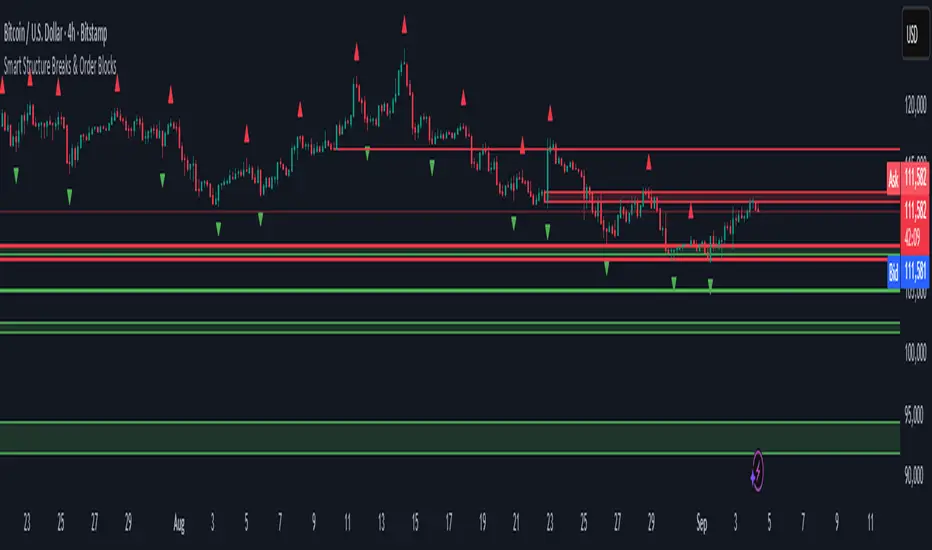
Volume-Weighted Money Flow [sgbpulse]Overview
The VWMF indicator is an advanced technical analysis tool that combines and summarizes five leading momentum and volume indicators (OBV, PVT, A/D, CMF, MFI) into one clear oscillator. The indicator helps to provide a clear picture of market sentiment by measuring the pressure from buyers and sellers. Unlike single indicators, VWMF provides a comprehensive view of market money flow by weighting existing indicators and presenting them in a uniform and understandable format.
Indicator Components
VWMF combines the following indicators, each normalized to a range of 0 to 100 before being weighted:
On-Balance Volume (OBV): A cumulative indicator that measures positive and negative volume flow.
Price-Volume Trend (PVT): Similar to OBV, but incorporates relative price change for a more precise measure.
Accumulation/Distribution Line (A/D): Used to identify whether an asset is being bought (accumulated) or sold (distributed).
Chaikin Money Flow (CMF): Measures the money flow over a period based on the close price's position relative to the candle's range.
Money Flow Index (MFI): A momentum oscillator that combines price and volume to measure buying and selling pressure.
Understanding the Normalized Oscillators
The indicator combines the five different momentum indicators by normalizing each one to a uniform range of 0 to 100 .
Why is Normalization Important?
Indicators like OBV, PVT, and the A/D Line are cumulative indicators whose values can become very large. To assess their trend, we use a Moving Average as a dynamic reference line . The Moving Average allows us to understand whether the indicator is currently trending up or down relative to its average behavior over time.
How Does Normalization Work?
Our normalization fully preserves the original trend of each indicator.
For Cumulative Indicators (OBV, PVT, A/D): We calculate the difference between the current indicator value and its Moving Average. This difference is then passed to the normalization process.
- If the indicator is above its Moving Average, the difference will be positive, and the normalized value will be above 50.
- If the indicator is below its Moving Average, the difference will be negative, and the normalized value will be below 50.
Handling Extreme Values: To overcome the issue of extreme values in indicators like OBV, PVT, and the A/D Line , the function calculates the highest absolute value over the selected period. This value is used to prevent sharp spikes or drops in a single indicator from compromising the accuracy of the normalization over time. It's a sophisticated method that ensures the oscillators remain relevant and accurate.
For Bounded Indicators (CMF, MFI): These indicators already operate within a known range (for example, CMF is between -1 and 1, and MFI is between 0 and 100), so they are normalized directly without an additional reference line.
Reference Line Settings:
Moving Average Type: Allows the user to choose between a Simple Moving Average (SMA) and an Exponential Moving Average (EMA).
Volume Flow MA Length: Allows the user to set the lookback period for the Moving Average, which affects the indicator's sensitivity.
The 50 line serves as the new "center line." This ensures that, even after normalization, the determination of whether a specific indicator supports a bullish or bearish trend remains clear.
Settings and Visual Tools
The indicator offers several customization options to provide a rich analysis experience:
VWMF Oscillator (Blue Line): Represents the weighted average of all five indicators. Values above 50 indicate bullish momentum, and values below 50 indicate bearish momentum.
Strength Metrics (Bullish/Bearish Strength %): Two metrics that appear on the status line, showing the percentage of indicators supporting the current trend. They range from 0% to 100%, providing a quick view of the strength of the consensus.
Dynamic Background Colors: The background color of the chart automatically changes to bullish (a blue shade by default) or bearish (a default brown-gray shade) based on the trend. The transparency of the color shows the consensus strength—the more opaque the background, the more indicators support the trend.
Advanced Settings:
- Background Color Logic: Allows the user to choose the trigger for the background color: Weighted Value (based on the combined oscillator) or Strength (based on the majority of individual indicators).
- Weights: Provides full control over the weight of each of the five indicators in the final oscillator.
Using the Data Window
TradingView provides a useful Data Window that allows you to see the exact numerical values of each normalized oscillator separately, in addition to the trend strength data.
You can use this window to:
Get more detailed information on each indicator: Viewing the precise numerical data of each of the five indicators can help in making trading decisions.
Calibrate weights: If you want to manually adjust the indicator weights (in the settings menu), you can do so while tracking the impact of each indicator on the weighted oscillator in the Data Window.
The indicator's default setting is an equal weight of 20% for each of the five indicators.
Alert Conditions
The indicator comes with a variety of built-in alerts that can be configured through the TradingView alerts menu:
VWMF Cross Above 50: An alert when the VWMF oscillator crosses above the 50 line, indicating a potential bullish momentum shift.
VWMF Cross Below 50: An alert when the VWMF oscillator crosses below the 50 line, indicating a potential bearish momentum shift.
Bullish Strength: High But Not Absolute Consensus: An alert when the bullish trend strength reaches 60% or more but is less than 100%, indicating a high but not absolute consensus.
Bullish Strength at 100%: An alert when all five indicators (MFI, OBV, PVT, A/D, CMF) show bullish strength, indicating a full and absolute consensus.
Bearish Strength: High But Not Absolute Consensus: An alert when the bearish trend strength reaches 60% or more but is less than 100%, indicating a high but not absolute consensus.
Bearish Strength at 100%: An alert when all five indicators (MFI, OBV, PVT, A/D, CMF) show bearish strength, indicating a full and absolute consensus.
Summary
The VWMF indicator is a powerful, all-in-one tool for analyzing market momentum, money flow, and sentiment. By combining and normalizing five different indicators into a single oscillator, it offers a holistic and accurate view of the market's underlying trend. Its dynamic visual features and customizable settings, including the ability to adjust indicator weights, provide a flexible experience for both novice and experienced traders. The built-in alerts for momentum shifts and trend consensus make it an effective tool for spotting trading opportunities with confidence. In essence, VWMF distills complex market data into clear, actionable signals.
Important Note: Trading Risk
This indicator is intended for educational and informational purposes only and does not constitute investment advice or a recommendation for trading in any form whatsoever.
Trading in financial markets involves significant risk of capital loss. It is important to remember that past performance is not indicative of future results. All trading decisions are your sole responsibility. Never trade with money you cannot afford to lose.
Pine Script® インジケーター
