Thermal Momentum Gauge [JOAT]Thermal Momentum Gauge
Introduction
The Thermal Momentum Gauge is an open-source institutional-grade pressure and volatility monitoring system that combines market pressure measurement, volatility temperature analysis, volume steam detection, and multi-factor explosion identification into a unified oscillator. This sophisticated system integrates multiple proven momentum methodologies to identify high-probability explosive move conditions where pressure, temperature, and steam factors converge.
The indicator is designed for traders who understand that explosive market moves occur when multiple pressure systems align simultaneously. By synthesizing RSI pressure, WaveTrend momentum, Money Flow Index analysis, Stochastic pressure, ATR temperature, Bollinger Band width, volume steam detection, and confluence scoring, this tool helps identify structural market explosion points with thermal precision.
Why This Integration Exists
This indicator combines seven distinct pressure and volatility measurement frameworks that complement each other:
Multi-Component Pressure System: Combines RSI, WaveTrend, MFI, and Stochastic RSI for comprehensive pressure measurement
Thermal Temperature Analysis: Uses ATR and Bollinger Band width to measure market volatility temperature
Volume Steam Detection: Analyzes volume spikes and directional volume pressure for steam identification
Explosion Detection Engine: Multi-factor confluence system that identifies when all pressure systems align
Momentum Confirmation System: Ensures signals occur at genuine turning points through momentum analysis
Pressure Zone Classification: Defines thermal zones from extreme oversold to extreme overbought
Signal Filtering System: Prevents overlapping signals while maintaining precision timing
Each component addresses different aspects of market thermal dynamics. Pressure measurement reveals directional bias, temperature analysis shows volatility energy, steam detection indicates volume explosions, and confluence scoring quantifies setup quality. Together, they create a comprehensive thermal view that traditional single-dimension momentum indicators cannot provide.
Core Components Explained
1. Multi-Component Pressure System (0-100 Scale)
The system combines four pressure measurements for comprehensive analysis:
RSI Pressure:
RSI Pressure = RSI(close, rsi_length) // Standard 0-100 scale
WaveTrend Pressure:
ESA = ema(hlc3, wt_channel_length)
D = ema(abs(hlc3 - ESA), wt_channel_length)
CI = (hlc3 - ESA) / (0.015 * D)
WT1 = ema(CI, wt_average_length)
WT Pressure = (WT1 + 100) / 2 // Normalize -100 to 100 → 0 to 100
MFI Pressure:
MFI Pressure = MFI(hlc3, mfi_length) // Money Flow Index 0-100
Stochastic RSI Pressure (Optional):
Stochastic RSI = Stochastic(RSI(close, rsi_length), stoch_length)
Stoch Pressure = sma(Stochastic RSI, 3)
Combined Pressure:
Total Pressure = (RSI + WT + MFI + Stoch) / 4 // With Stochastic
Total Pressure = (RSI + WT + MFI) / 3 // Without Stochastic
2. Thermal Temperature System (0-100 Scale)
Measures market volatility energy through dual methods:
ATR-Based Temperature:
ATR Percentage = (ATR(atr_length) / close) * 100
ATR Temperature = ATR Percentage * temperature_multiplier
Bollinger Band Width Temperature (Optional):
BB Basis = sma(close, bb_length)
BB Deviation = bb_multiplier * stdev(close, bb_length)
BB Width = ((BB Upper - BB Lower) / BB Basis) * 100
BB Temperature = BB Width * 5 // Scale to 0-100
Combined Temperature:
Temperature = min((ATR Temperature + BB Temperature) / 2, 100) // With BB
Temperature = min(ATR Temperature, 100) // Without BB
3. Volume Steam Detection (0-100 Scale)
Analyzes volume explosions and directional pressure:
Volume Steam Base:
Volume Ratio = volume / sma(volume, volume_length)
Steam Base = Volume Ratio * 50
Volume Delta (Optional):
Buy Volume = close > open ? volume : 0
Sell Volume = close < open ? volume : 0
Volume Delta = (Buy Volume - Sell Volume) / volume * 50
Combined Steam:
Steam = min(Steam Base + abs(Volume Delta), 100)
Steam Classifications:
- Steam Burst: Steam > steam_threshold (default 80)
- Extreme Steam: Steam > 90
- Volume Spike Direction: Bullish (close > open) or Bearish (close < open)
4. Explosion Detection Engine
Multi-factor confluence system with momentum confirmation:
Momentum Confirmation:
Pressure Momentum = change(Total Pressure)
Pressure Acceleration = change(Pressure Momentum)
Momentum Shift = (momentum > 0 AND momentum <= 0) OR (momentum < 0 AND momentum >= 0)
Confluence Score (0-5):
Confluence Components:
- Pressure Factor: Total Pressure > pressure_threshold ? 1 : 0
- Temperature Factor: Temperature > temperature_threshold ? 1 : 0
- Steam Factor: Steam > steam_threshold ? 1 : 0
- WaveTrend Extreme: WT Pressure > 80 OR WT Pressure < 20 ? 1 : 0
- Extreme Steam: Steam > 90 ? 1 : 0
Confluence Score = Sum of all factors (0-5)
Explosion Conditions:
Explosion = Confluence Score >= minimum_confluence AND (Momentum Shift OR abs(Pressure Acceleration) > 2)
Bull Explosion = Explosion AND Total Pressure > 50 AND Pressure Momentum > 0
Bear Explosion = Explosion AND Total Pressure < 50 AND Pressure Momentum < 0
Perfect Explosion (Rare):
Perfect Explosion = Confluence Score == 5 AND abs(Pressure Momentum) > 3
Perfect Bull = Perfect Explosion AND Total Pressure > 50 AND Pressure Momentum > 0
Perfect Bear = Perfect Explosion AND Total Pressure < 50 AND Pressure Momentum < 0
5. Thermal Zone Classification
The system defines seven thermal pressure zones:
Extreme Overbought: Pressure > 80 (Critical thermal level)
Overbought: Pressure 70-80 (High thermal level)
Neutral High: Pressure 55-70 (Warm thermal level)
Equilibrium: Pressure 45-55 (Neutral thermal zone)
Neutral Low: Pressure 30-45 (Cool thermal level)
Oversold: Pressure 20-30 (Low thermal level)
Extreme Oversold: Pressure < 20 (Critical thermal level)
6. Signal Filtering System
Prevents overlapping signals while maintaining precision:
Minimum Bars Between Signals = 8
Signal Filtering Logic:
- Perfect signals take priority over regular explosions
- Regular explosions are filtered if perfect signal occurred recently
- Warning signals are filtered if explosion signals are active
- Steam bursts are filtered to minimum 3 bars apart
Visual Elements
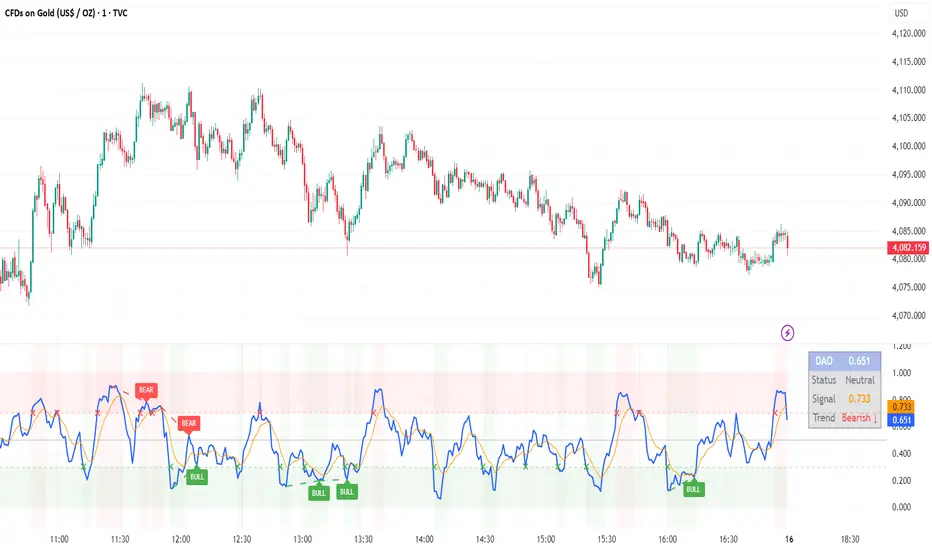
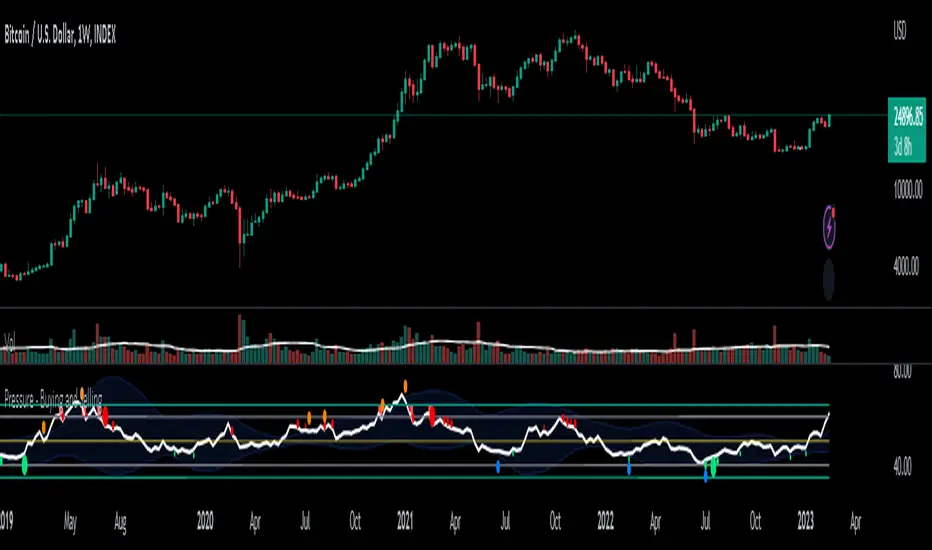
Thermal Pressure Wave: Main oscillator with thermal gradient coloring and glow effects
Component Pressures: Individual RSI, WT, MFI, and Stochastic lines (hidden by default)
Temperature Background: Heat map style background coloring based on volatility temperature
Steam Burst Histograms: Volume spike visualization with directional coloring
Thermal Zone References: Critical levels at 20, 30, 50, 70, 80 with neutral zone highlighting
Explosion Markers: Diamond shapes for perfect explosions, triangles for regular explosions
Warning Signals: Circle markers for approaching explosion conditions
Pressure Meter: Visual gauge showing current pressure level with thermal gradient
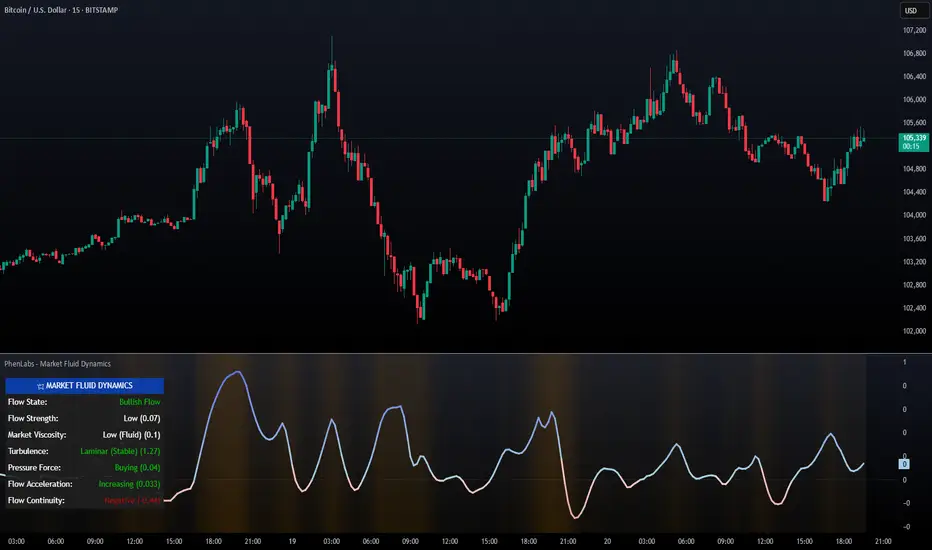
Dashboard: Comprehensive real-time display of all thermal components and status
How Components Work Together
The integration creates a thermal momentum analysis approach:
Layer 1 - Pressure Measurement: Multi-component system reveals directional pressure across four dimensions
Layer 2 - Temperature Analysis: Volatility measurement shows market energy and expansion potential
Layer 3 - Steam Detection: Volume analysis identifies explosive energy release conditions
Layer 4 - Momentum Confirmation: Ensures signals occur at genuine turning points, not random noise
Layer 5 - Confluence Scoring: Quantifies setup quality by counting aligned factors
Layer 6 - Explosion Detection: Identifies rare moments when all thermal systems align
Layer 7 - Signal Filtering: Prevents overlap while maintaining precision timing
Example scenario: Pressure reaches extreme oversold (Layer 1) with high temperature (Layer 2), volume steam burst (Layer 3), momentum shift confirmation (Layer 4), confluence score of 5 (Layer 5), triggering perfect bull explosion (Layer 6) with proper signal filtering (Layer 7). This represents maximum thermal alignment for explosive upward move.
Input Parameters
Pressure Settings:
RSI Length: Period for RSI calculation (default: 14)
WT Channel Length: WaveTrend channel period (default: 10)
WT Average Length: WaveTrend smoothing period (default: 21)
MFI Length: Money Flow Index period (default: 14)
Stochastic Length: Stochastic RSI period (default: 14)
Use Stochastic Pressure: Toggle fourth pressure component
Temperature Settings:
ATR Length: Average True Range period (default: 14)
Temperature Multiplier: Sensitivity adjustment (default: 10.0)
Use Bollinger Band Width: Toggle BB width temperature component
BB Length: Bollinger Band period (default: 20)
BB Multiplier: Bollinger Band deviation (default: 2.0)
Volume Settings:
Volume MA Length: Volume average period (default: 20)
Steam Threshold: Volume spike multiplier (default: 2.0)
Use Volume Delta: Toggle directional volume analysis
Show Volume Spikes: Toggle volume spike visualization
Explosion Settings:
Pressure Threshold: Minimum pressure for explosion (default: 80)
Temperature Threshold: Minimum temperature for explosion (default: 70)
Steam Threshold: Minimum steam for explosion (default: 80)
Minimum Confluence Score: Required factors for explosion (default: 3)
Show Explosion Warnings: Toggle warning markers
How to Use This Indicator
Step 1: Assess Thermal Pressure
Check the main pressure gauge and current thermal zone classification in the dashboard.
Step 2: Monitor Temperature Levels
High temperature (>70) indicates market energy building for potential explosive moves.
Step 3: Watch for Steam Bursts
Volume steam bursts (>80) show explosive energy release with directional bias.
Step 4: Check Confluence Score
Scores ≥3 indicate multiple thermal factors aligning for explosion potential.
Step 5: Wait for Momentum Confirmation
Explosions require momentum shifts or acceleration to confirm genuine turning points.
Step 6: Identify Explosion Signals
Perfect explosions (diamond markers) offer highest probability, regular explosions (triangles) offer good probability.
Step 7: Monitor Warning Signals
Warning markers indicate approaching explosion conditions - prepare for potential signals.
Best Practices
Use on 15-minute to 4-hour timeframes for optimal thermal detection
Focus on extreme thermal zones (<20 or >80) for highest explosion probability
Perfect explosions are rare but offer exceptional risk:reward opportunities
Temperature confirmation adds conviction to pressure-based signals
Steam direction (bullish/bearish) should align with expected explosion direction
Confluence scores ≥4 significantly increase explosion probability
Warning signals help prepare for upcoming explosion opportunities
Thermal zone transitions often precede significant price movements
Indicator Limitations
Thermal pressure can remain extreme longer than expected during strong trends
Perfect explosions are rare - patience required for highest probability setups
Temperature spikes during news events may create false explosion signals
Steam bursts don't guarantee immediate price movement - timing varies
Confluence scoring is mathematical, not predictive of future performance
Component pressures may conflict, requiring interpretation skills
Signal filtering may delay signals in rapidly changing market conditions
Requires understanding of multi-factor thermal analysis concepts
Technical Implementation
Built with Pine Script v6 using:
Multi-component pressure calculation with optional Stochastic RSI integration
Dual-method temperature analysis using ATR and Bollinger Band width
Advanced volume steam detection with directional bias measurement
Multi-factor confluence scoring system with momentum confirmation
Thermal gradient coloring system with glow effects and heat map backgrounds
Anti-overlap signal filtering with priority-based signal management
Real-time pressure meter visualization with thermal zone classification
Comprehensive dashboard with component breakdown and explosion status
The code is fully open-source and can be modified to suit individual trading styles and preferences.
Originality Statement
This indicator is original in its thermal momentum integration approach. While individual components (RSI, WaveTrend, MFI, ATR, volume analysis) are established concepts, this integration is justified because:
It synthesizes seven distinct thermal and momentum methodologies into a unified system
The multi-component pressure system provides comprehensive momentum analysis beyond single indicators
Thermal temperature analysis combines volatility measurements for energy assessment
Volume steam detection adds explosive energy context to momentum signals
Multi-factor confluence scoring quantifies setup quality across all thermal dimensions
Perfect explosion detection identifies rare, high-probability explosive move conditions
Each component contributes unique thermal information: pressure measurement reveals directional momentum, temperature analysis shows volatility energy, steam detection indicates volume explosions, confluence scoring quantifies alignment, and momentum confirmation ensures signal quality. The integration's value lies in identifying moments when all thermal systems align simultaneously for explosive market moves.
Disclaimer
This indicator is provided for educational and informational purposes only. It is not financial advice or a recommendation to buy or sell any financial instrument. Trading involves substantial risk of loss and is not suitable for all investors.
Thermal momentum analysis and explosion detection are analytical concepts that do not guarantee future price movement. Past performance and backtested results do not guarantee future results. Market conditions change, and thermal patterns that worked historically may not work in the future.
Always use proper risk management, including stop losses and position sizing appropriate for your account size and risk tolerance. Never risk more than you can afford to lose. Consider consulting with a qualified financial advisor before making investment decisions.
The author is not responsible for any losses incurred from using this indicator. Users assume full responsibility for all trading decisions made using this tool.
-Made with passion by officialjackofalltrades
Pine Script® インジケーター