TASC 2025.02 Autocorrelation Indicator█ OVERVIEW
This script implements the Autocorrelation Indicator introduced by John Ehlers in the "Drunkard's Walk: Theory And Measurement By Autocorrelation" article from the February 2025 edition of TASC's Traders' Tips . The indicator calculates the autocorrelation of a price series across several lags to construct a periodogram , which traders can use to identify market cycles, trends, and potential reversal patterns.
█ CONCEPTS
Drunkard's walk
A drunkard's walk , formally known as a random walk , is a type of stochastic process that models the evolution of a system or variable through successive random steps.
In his article, John Ehlers relates this model to market data. He discusses two first- and second-order partial differential equations, modified for discrete (non-continuous) data, that can represent solutions to the discrete random walk problem: the diffusion equation and the wave equation. According to Ehlers, market data takes on a mixture of two "modes" described by these equations. He theorizes that when "diffusion mode" is dominant, trading success is almost a matter of luck, and when "wave mode" is dominant, indicators may have improved performance.
Pink spectrum
John Ehlers explains that many recent academic studies affirm that market data has a pink spectrum , meaning the power spectral density of the data is proportional to the wavelengths it contains, like pink noise . A random walk with a pink spectrum suggests that the states of the random variable are correlated and not independent. In other words, the random variable exhibits long-range dependence with respect to previous states.
Autocorrelation function (ACF)
Autocorrelation measures the correlation of a time series with a delayed copy, or lag , of itself. The autocorrelation function (ACF) is a method that evaluates autocorrelation across a range of lags , which can help to identify patterns, trends, and cycles in stochastic market data. Analysts often use ACF to detect and characterize long-range dependence in a time series.
The Autocorrelation Indicator evaluates the ACF of market prices over a fixed range of lags, expressing the results as a color-coded heatmap representing a dynamic periodogram. Ehlers suggests the information from the periodogram can help traders identify different market behaviors, including:
Cycles : Distinguishable as repeated patterns in the periodogram.
Reversals : Indicated by sharp vertical changes in the periodogram when the indicator uses a short data length .
Trends : Indicated by increasing correlation across lags, starting with the shortest, over time.
█ USAGE
This script calculates the Autocorrelation Indicator on an input "Source" series, smoothed by Ehlers' UltimateSmoother filter, and plots several color-coded lines to represent the periodogram's information. Each line corresponds to an analyzed lag, with the shortest lag's line at the bottom of the pane. Green hues in the line indicate a positive correlation for the lag, red hues indicate a negative correlation (anticorrelation), and orange or yellow hues mean the correlation is near zero.
Because Pine has a limit on the number of plots for a single indicator, this script divides the periodogram display into three distinct ranges that cover different lags. To see the full periodogram, add three instances of this script to the chart and set the "Lag range" input for each to a different value, as demonstrated in the chart above.
With a modest autocorrelation length, such as 20 on a "1D" chart, traders can identify seasonal patterns in the price series, which can help to pinpoint cycles and moderate trends. For instance, on the daily ES1! chart above, the indicator shows repetitive, similar patterns through fall 2023 and winter 2023-2024. The green "triangular" shape rising from the zero lag baseline over different time ranges corresponds to seasonal trends in the data.
To identify turning points in the price series, Ehlers recommends using a short autocorrelation length, such as 2. With this length, users can observe sharp, sudden shifts along the vertical axis, which suggest potential turning points from upward to downward or vice versa.
"Cycle"に関するスクリプトを検索
Moon Phases 2026-2035Moon Phases 2026–2035
This custom indicator displays moon phases as vertical lines on your chart, allowing traders to observe and study potential relationships between lunar cycles and market behavior.
This indicator is best used on the Daily timeframe. Lunar cycles tend to align more clearly with price action when viewed on daily bars, making it easier to analyze broader market trends and patterns.
Key Features
Moon Phases (2026–2035)
Displays the four major lunar phases — New Moon, First Quarter, Full Moon, and Last Quarter — from 2026 through 2035 , marked clearly with vertical lines on the chart.
Clear Visual Markers
Each moon phase is represented consistently, making it easy to spot potential turning points, volatility changes, or cyclical behavior in price action.
Customizable Display
You can toggle the visibility of individual moon phases (New Moon, First Quarter, Full Moon, Last Quarter) to focus only on the phases you find most relevant.
Why Moon Phases Matter in Trading
Some traders believe lunar cycles can influence market sentiment and price movement. Common interpretations include:
New Moon : Often associated with new beginnings or potential reversals.
Full Moon : Frequently linked to heightened volatility or market extremes.
First Quarter & Last Quarter : May coincide with consolidation phases or momentum shifts.
This indicator allows you to visually align these lunar events with price data, helping you incorporate cyclical analysis into your broader trading approach.
Disclaimer
The information and publications provided by this indicator are not intended to be, and do not constitute, financial, investment, trading, or other types of advice. Always conduct your own analysis and manage risk appropriately.
Pine Script® インジケーター
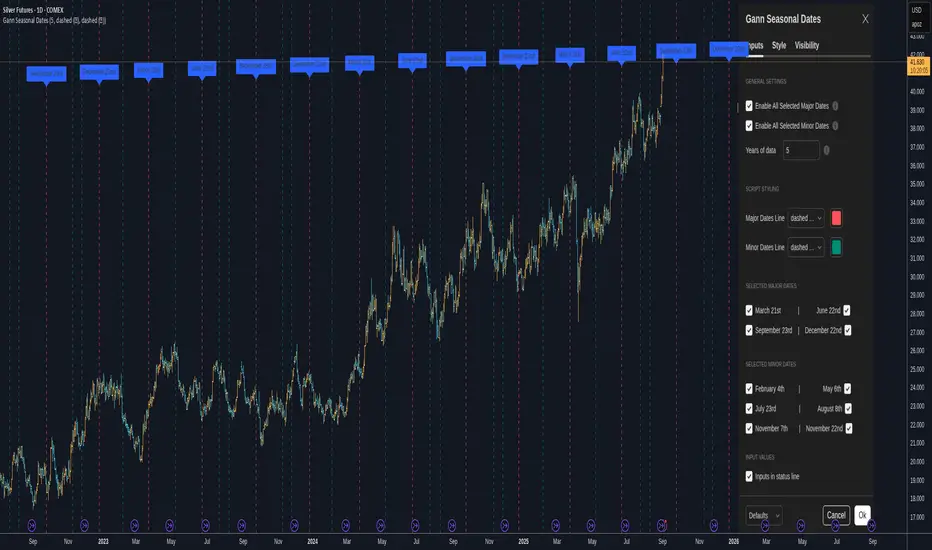
Gann Seasonal Dates - CEGann Seasonal Dates - Community Edition
Welcome to the Gann Seasonal Dates V1.61 - Community Edition, a powerful tool designed to enhance time-based trading with W.D. Gann’s seasonal date methodology. This feature-complete indicator allows traders to plot critical seasonal dates on charts for equities, forex, commodities, and cryptocurrencies. It empowers traders to anticipate market turning points with precision.
Overview
The Gann Seasonal Dates plots Gann’s major and minor seasonal dates, which are rooted in the cyclical nature of solstices, equinoxes, and their midpoints. Major dates include the vernal equinox (March 21st), summer solstice (June 22nd), autumnal equinox (September 23rd), and winter solstice (December 22nd). Minor dates mark the halfway points between these events (February 4th, May 6th, July 23rd, August 8th, November 7th, and November 22nd). With customizable styling and historical data up to 50 years, this script helps traders identify key time-based market events.
Key Features
Major and Minor Seasonal Dates : Plot four major dates (solstices and equinoxes) and six minor dates (midpoints) to highlight potential market turning points.
Customizable Date Selection : Enable or disable individual major and minor dates to focus on specific cycles relevant to your analysis.
Historical Data Range : Adjust the lookback period up to 50 years, with recommendations for optimal performance based on your TradingView plan (5 years for Basic, 20 for Pro/Pro+/Premium).
Styling Options : Customize line styles (solid, dotted, dashed) and colors for major and minor dates to enhance chart clarity.
Labeled Visuals : Each plotted date includes a label with a tooltip (e.g., "Vernal equinox") for easy identification and context.
How It Works
Configure Settings : Enable major and/or minor dates and select specific dates (e.g., March 21st, February 4th) to display on your chart.
Set Historical Range : Adjust the years of data (up to 50) to plot historical seasonal dates, ensuring compatibility with your TradingView plan’s processing limits.
Customize Styling : Choose line styles and colors for major and minor dates to differentiate them visually.
Analyze and Trade : Use the plotted vertical lines and labels to identify potential market turning points, integrating Gann’s time-based cycles into your strategy.
Get Started
As a gift to the TradingView community and Gann traders, the Gann Seasonal Dates - Community Edition is provided free of charge. With no features locked, this tool offers full access to Gann’s seasonal date methodology for precise time-based analysis. Trade wisely and leverage the power of seasonal cycles!
Pine Script® インジケーター
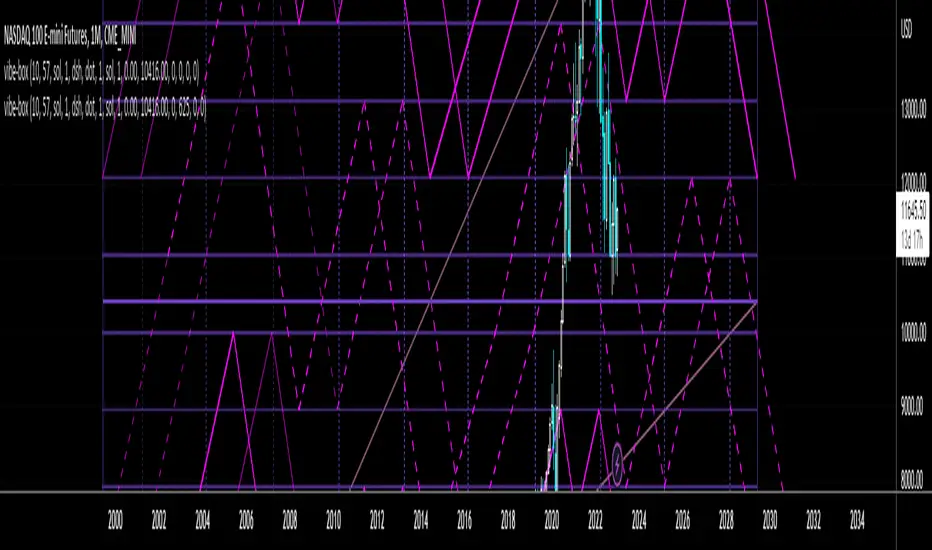
Vibration BoxFirst Public release of the Vibration Box
WARNING - THESE CYCLES CANNOT PREDICT PERFECT "UP & DOWN" MOTION
There is absolutely no guarantee that these cycles will predict perfect "up & down" motion for the markets
Please be aware that this tool is to be used with a robust risk management system
These cycles are representative of "circle geometry within a square of price & time"
Slowly, I will build up some ideas to go along with this script so that you can learn to apply it to many different markets in many different ways
Those familiar with the work of W.D. Gann should be able to utilize this tool in many different ways
Instructions:
Place the box down with 2 mouse clicks (first is for bottom left corner & second is for top right corner)
NOTE: DUE TO TRADINGVIEW LIMITATIONS
-There is a maximum of 12 divisions for your box/vibration (I will work on increasing this number)
-You MUST choose a coordinate that is within the price action that has already occurred
-You CANNOT initially place the box BEFORE THE FIRST BAR of data
-You CANNOT initially place the box BEYOND THE LAST BAR of data
THEN, ONCE YOU HAVE PLACED THE BOX FOR THE FIRST TIME
YOU CAN MANUALLY ADJUST THE DATES WITHIN THE SETTINGS TO PLACE THE BOX IN ANYWAY YOU WOULD LIKE!
Pine Script® インジケーター
Cycle & Flow Indicator - D_QuantCycle & Flow Architecture (CFA) | Multi-Factor Regime Analysis
Overview
The Cycle & Flow Architecture (CFA) is a trend-following visualization engine that utilizes a triple-confirmation "Voting Mechanism" to identify market regimes. Rather than relying on a single lagging indicator, the CFA aggregates Cyclical Momentum, Directional Bias, and Volume Flow from the Daily timeframe to provide a unified consensus signal on your current chart.
The goal of this script is to filter market noise by requiring a quantitative agreement between three non-correlated mathematical models before a "Regime Change" is visualized.
The Quantitative Logic
The core of the CFA is its Aggregation Engine, which calculates a normalized Quant Score ranging from -1.0 to +1.0. The engine polls three distinct components:
Schaff Trend Cycle (STC): This component identifies the cyclical nature of price. It applies a double-smoothed stochastic process to a MACD line. In this script, the STC contributes a bullish signal when the cycle is above 25 and a bearish signal when the cycle is below 75 and falling.
Parabolic SAR (PSAR): Used as a rigid directional filter. It calculates the "Stop and Reverse" points, if the price is above the PSAR, it contributes a +1 to the consensus, if below, a -1.
Ease of Movement (EOM): This is the volume-validation component. It analyzes the relationship between price change and volume. A positive EOM suggests price is moving up on light resistance (conviction), while negative EOM suggests easy downward movement.
How it Works: The Voting Mechanism
The script calculates these three values on the Daily (D) timeframe using request.security to ensure higher-timeframe confluence.
Bullish Regime: Triggered when the average score exceeds the Bullish Threshold (Default: 0.2).
Bearish Regime: Triggered when the average score falls below the Bearish Threshold (Default: -0.2).
Neutral Regime: When the components disagree or the scores hover near zero, the engine renders a "Grey" noise state, signaling a high-probability "sit on hands" environment.
How to Use
The Ghost Cloud: The central Hull Moving Average (HMA 20) acts as the baseline. The "cloud" fills between this baseline and the price, colored by the current Score.
Volatility Extensions: The script plots ATR-based bands (14-period) that only appear during confirmed regimes. In a Bullish regime, the upper band appears, in a Bearish regime, the lower.
Trade Execution: Traders typically look for the "Bullish/Bearish Start" alerts to signal the beginning of a new regime and use the "Grey" neutral zones to tighten stop-losses or exit positions.
Settings
Thresholds: Increase the Bullish/Bearish thresholds (e.g., to 0.5) to require more stringent agreement between the STC, PSAR, and EOM.
Timeframe Note: The calculations are hardcoded to the Daily timeframe to provide a "North Star" directional bias regardless of whether you are viewing the 15m or 4h chart.
Disclaimer: This tool is for educational and analytical purposes only. Quantitative models represent mathematical probabilities, not guarantees.
© D_QUANT
Pine Script® インジケーター
IPDA Time High/L🧭 IPDA Time Pivot High/Low (3•6•9)
Precision timing meets liquidity delivery.
🔹 Concept
This tool is built on the idea that price is delivered by time, not structure — a core belief in Zeussy/Smart Money–style analysis.
Certain time signatures, known as IPDA times (where the digits of hour and minute reduce to 3, 6, or 9), often align with reversals, traps, or accelerations in market delivery.
These times represent rhythmic energy cycles in algorithmic delivery, marking when liquidity is often redistributed.
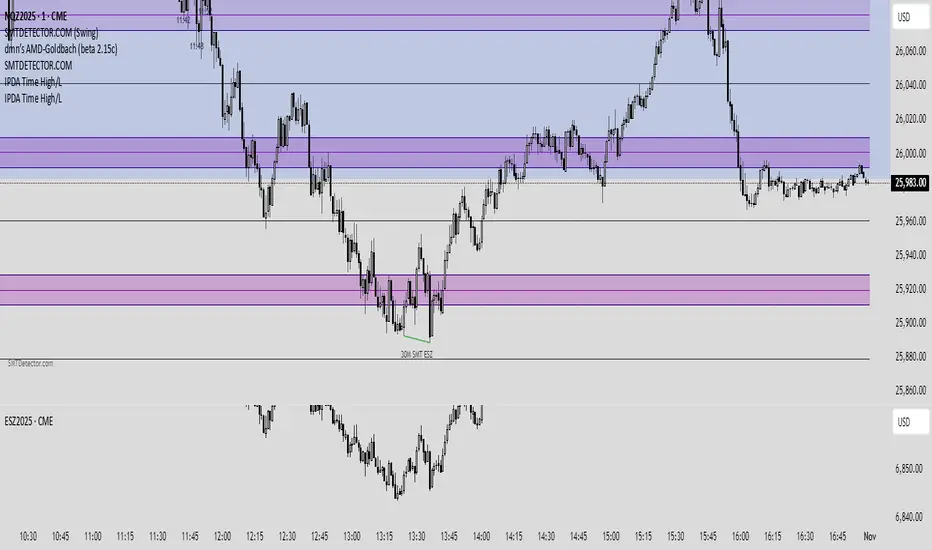
🔹 What the Indicator Does
Scans your selected time window (default: 9:00–11:00, New York).
Identifies candles forming micro pivots — a candle that’s higher or lower than both its immediate neighbors.
Filters only those pivots that occur at IPDA times (digital roots of 3, 6, or 9).
Prints a clean, minimal time label (HH:MM) above or below each qualifying candle.
Labels dynamically adjust to your chart’s timezone and vertical spacing for clarity.
🔹 Why It’s Useful
These moments often align with:
Engineered traps during liquidity hunts.
Session transitions (e.g., London → NY Open).
Delivery shifts where price changes direction into the Draw on Liquidity (DOL).
By highlighting only precise, time-based pivots, this indicator helps traders:
Anticipate timing-based reversals,
Align narrative with smart-money delivery cycles,
And build refined entries within the NY AM session.
🔹 How to Use
Apply the indicator to your chart.
Set the timezone (default: America/New_York).
Focus on your session window (e.g., 09:00–11:00).
Observe when price reaches your POI or liquidity pool during an IPDA time — those candles are often where manipulation or delivery begins.
Combine with your own narrative tools (SMT, CISD, DOL, POI) for confirmation.
🔹 Features
Automatic timezone alignment
Adjustable session hours
Transparent, minimalistic time labels
Custom label size & offset for clean chart aesthetics
Works on all intraday timeframes
🔹 Philosophy
“Price is delivered by time, not structure.”
— Zeussy
This indicator was designed for traders who study timing as a function of delivery,
not just structure — allowing you to see when the algorithm intends to act.
Pine Script® インジケーター
Nancy's All-In-One [Private] [Institutional]A Private Institutional Tool by Design
PRIVATE ACCESS ONLY
This script is not for public usage or those casually scrolling through the indicator library. This is a private tool, built for precision, and extremely powerful in the wrong hands. Used properly, it can unlock financial freedom yes, it’s that potent.
“This is the closest you’ll get to peeking behind the curtain of institutional strategy without having a Bloomberg terminal or a Wall Street badge.”
– KC Research
What It Does
The Nancy All-In-One is the culmination of thousands of hours of backtesting, real-world application, and tactical insights drawn from elite strategies used at places like Renaissance Technologies, proprietary desks, and private equity firms.
This version fuses:
DTT Root Candles & Time-Zone Price Levels (including NY Judas, Kyoto, Osaka, etc.)
Intraday Sessions & Micro Box Models (Turncoat, Bishop, Knight, Big Ben, etc.)
Quarterly Micro Cycles — breaks down time into high-probability 90-minute blocks
Fib-Based Inner Intervals — ideal for sniper-level scalps or early entries
SMT Divergences, PD High/Low, NWOG/NDOG/EHPDA setups
Multi-Timeframe Visualization (with user control over display resolution)
Every line, label, and box drawn has a purpose, engineered to expose fractal imbalances, liquidity traps, and premium/discount zones with surgical accuracy.
How to Use It
Use the 1M or 5M chart — This script was optimized with lower-timeframe precision in mind. It works higher up, but that’s not its primary edge.
Turn on sessions you want under Turn Modules On group. Each session represents a model with its own behavior (e.g. Osaka Model = Asia liquidity expansion).
Price Lines — The "DTT Root Candles" levels are critical. These are not random timestamps—they represent algorithmic triggers derived from real volume and timing analysis.
Quarterly Cycles — Use these to trade from zone-to-zone with context. Each 90-minute block often contains a reversal, breakout, or liquidity sweep.
SMT, PDHL, NWOG, NDOG — These are best used with confluence. The more boxes and lines that agree, the higher your confidence.
Built for Traders Who Know the Game
This is not a magic button. It’s a complex system that assumes you're willing to study it, adapt it, and integrate it into your own strategy. It’s a tool—not a signal generator. It won't tell you when to buy or sell, but it will show you exactly where institutions are hunting.
Settings & Customization
You can toggle each element on/off to declutter your chart.
Change label sizes, opacity, and styles to suit your preferences.
Adjust session times if you're not in EST (UTC-5 default).
Works Best With:
1M to 15M charts (although elements scale up)
Liquid FX pairs, indices (SPX, NAS100), BTC, and ETH
Time-sensitive entries (news, killzones, session opens)
Final Note
This was developed internally by Nancy and private anon entities, and is still being actively expanded. Portions of the code are open-source, but most logic is proprietary and reverse-engineering resistant.
If you don’t know what NWOG, EQH/PDH, or SMT are—this isn’t for you. If you do... welcome to the other side.
Pine Script® インジケーター
Planetary Speed - CEPlanetary Speed - Community Edition
Welcome to the Planetary Speed - Community Edition , a specialized tool designed to enhance W.D. Gann-inspired trading by plotting the speed of selected planets. This indicator measures changes in planetary ecliptic longitudes, which may correlate with market timing and volatility, making it ideal for traders analyzing equities, forex, commodities, and cryptocurrencies.
Overview
The Planetary Speed - Community Edition calculates the speed of a chosen planet (Mercury, Venus, Mars, Jupiter, Saturn, Uranus, Neptune, or Pluto) by comparing its ecliptic longitude across time. Supporting heliocentric and geocentric modes, the script plots speed data with high precision across various chart timeframes, particularly for markets open 24/7 like cryptocurrencies. Traders can customize line colors and add multiple instances for multi-planet analysis, aligning with Gann’s belief that planetary cycles influence market trends.
Key Features
Plots the speed of eight planets (Mercury, Venus, Mars, Jupiter, Saturn, Uranus, Neptune, Pluto) based on ecliptic longitude changes
Supports heliocentric and geocentric modes for flexible analysis
Customizes line colors for clear visualization of planetary speed data
Projects future speed data up to 250 days with daily resolution
Works across default TradingView timeframes (except monthly) for continuous markets
Enables multiple script instances for tracking different planets on the same chart
How to Use
Access the script’s settings to configure preferences
Choose a planet from Mercury, Venus, Mars, Jupiter, Saturn, Uranus, Neptune, or Pluto
Select heliocentric or geocentric mode for calculations
Customize the line color for speed data visualization
Review plotted speed data to identify potential market timing or volatility shifts
Add multiple instances to track different planets simultaneously
Get Started
The Planetary Speed - Community Edition provides full functionality for astrological market analysis. Designed to highlight Gann’s planetary cycles, this tool empowers traders to explore celestial influences. Trade wisely and harness the power of planetary speed!
Pine Script® インジケーター
Time Block with Current K-Line TimeThis indicator divides the market into fixed time blocks (daily, three-day, weekly, monthly, and yearly) and displays 1/4, 1/2, and 3/4 dividing lines within each block, indicating key price positions within the block.
————————————
Description:
1. Generally speaking, the duration of a market period is one time block within the corresponding period.
2. Supports display of the current candlestick time, the dividing line for the next block, and a countdown.
3. Multi-time zone support: Shanghai, New York, London, Tokyo, and UTC. Time display automatically adapts to the selected time zone.
4. Time block visualization: Select the time block length based on the observation period and draw dividers at the time block boundaries.
5. Real-time time display: Detailed time of the current candlestick chart (year/month/day, hour:minute, day of the week).
6. Future time prediction: Displays the next time block's start position with a future divider. A countdown function displays the time until the next block, helping to determine the remaining duration of the current trend.
————————————
Use scenarios:
Day trading: Identify trading day boundaries (1-day blocks)
Swing trading: Optimize weekly/monthly time frame transitions (1-week/1-month blocks)
Long-term investment: Observe annual market cycles (1-year blocks)
Cross-time zone trading: Seamlessly switch between major global trading time zones.
————————————
Functions:
- Time block division to observe market cycles
- Draw 1/4, 1/2, and 3/4 dividers to assist in trading decisions
- Current K-line Time Display
- Future Block Divider and Countdown Indicator
————————————
How to Use:
Can be combined with trend lines or other trend-following tools to identify trend-following entry opportunities near the dividing line and follow the main trend.
——————————————————————————————————————————————————————————
本指标将行情划分为固定时间区块(日、三日、周、月、年),并在每个区块内显示1/4、1/2、3/4分割线,标示区块内关键价格位置
————————————
描述:
1. 通常而言,一段行情的持续时间为对应周期下的一个时间区块
2. 支持显示当前K线时间及下一个区块的分割线和倒计时。
3. 多时区支持,支持上海、纽约、伦敦、东京、UTC五大交易时区,自适应所选时区的时间显示
4. 时间区块可视化:根据观测周期选择时间区块长度,在时间区块边界绘制分隔线
5. 实时时间显示:当前K线详细时间(年/月/日 时:分 星期)
6. 未来时间预测,下一个时间区块开始位置显示未来分割线,倒计时功能显示距离下个区块的时间,用于辅助判断当前趋势的剩余持续时间
————————————
使用场景:
日内交易:识别交易日边界(1日区块)
波段交易:把握周/月时间框架转换(1周/1月区块)
长期投资:观察年度市场周期(1年区块)
跨时区交易:无缝切换全球主要交易时区
————————————
功能:
- 时间区块划分,观察行情周期
- 绘制1/4、1/2、3/4分割线,辅助交易判断
- 当前K线时间显示
- 未来区块分割线及倒计时提示
————————————
使用方法:
可结合趋势线或其他趋势跟随工具,在分割线附近寻找顺势进场机会,追随主趋势
Pine Script® インジケーター
CVDD Z-ScoreCumulative Value Days Destroyed (CVDD) - The CVDD was created by Willy Woo and is the ratio of the cumulative value of Coin Days Destroyed in USD and the market age (in days). While this indicator is used to detect bottoms normally, an extension is used to allow detection of BTC tops. When the BTC price goes above the CVDD extension, BTC is generally considered to be overvalued. Because the "strength" of the BTC tops has decreased over the cycles, a logarithmic function for the extension was created by fitting past cycles as log extension = slope * time + intercept. This indicator is triggered for a top when the BTC price is above the CVDD extension. For the bottoms, the CVDD is shifted upwards at a default value of 120%. The slope, intercept, and CVDD bottom shift can all be modified in the script.
Now with the automatic Z-Score calculation for ease of classification of Bitcoin's valuation according to this metric.
Created for TRW.
Pine Script® インジケーター
Risk On/Off Index [SwissAlgo]Risk On/Off Index - Sector Rotation Analysis
----------------------------------------------------
What it does:
This indicator estimates market risk appetite by comparing the weighted performance of growth/cyclical sectors (Risk-On) against defensive sectors (Risk-Off).
It provides a normalized oscillator that ranges from -1 (extreme risk-off) to +1 (extreme risk-on), which may help traders identify potential shifts in market sentiment and sector rotation patterns.
The analysis examines whether institutional money flows favor aggressive growth assets or seek safety in defensive positions, potentially offering insights into the underlying risk tolerance that drives market movements. When properly interpreted alongside other analyses, this information could assist in understanding broader market cycles and sentiment transitions.
----------------------------------------------------
How it works:
The indicator analyzes 11 major sector ETFs weighted by their actual market capitalization representation:
Risk-On sectors (70% weight) : Technology (28%), Financials (11%), Consumer Discretionary (10%), Communication (9%), Industrials (8%), Energy (4%), Materials (2.5%), Real Estate (2%)
Risk-Off sectors (30% weight) : Healthcare (13%), Consumer Staples (6%), Utilities (2.5%)
The algorithm calculates the weighted performance difference over your selected timeframe (7 days to 12 months) and normalizes it using three methods: Simple Difference, Tanh Normalized, or Historical Range. A 7-period EMA smooths the signal, while a longer signal line (default 50) provides trend context.
----------------------------------------------------
Visual Features:
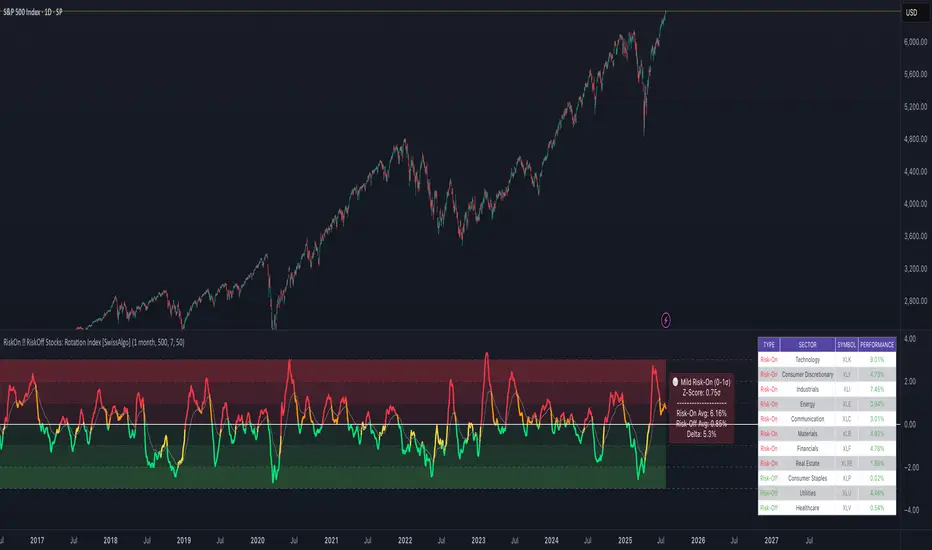
Main curve (Risk Appetite Delta) : The primary line shows the smoothed (7-period EMA) risk appetite reading. When above zero, growth sectors are outperforming defensive sectors (risk-on sentiment). When below zero, defensive sectors are outperforming growth sectors (risk-off sentiment).
Signal line : A longer EMA (default 50-period) of the risk appetite data that represents the underlying trend. Crossovers between the main curve and signal line may indicate potential momentum shifts in market sentiment (potential long signal when the crossover happens in extreme risk-off zones, and potential short signal when the crossunder occurs in extreme risk-on zones)
Dynamic color coding : The main curve color reflects both position and momentum:
Red : Risk-on territory (>0) with strengthening momentum (above signal line)
Green : Risk-on territory (>0) but weakening momentum (below signal line) - potential reversal warning
Maroon : Risk-off territory (<0) but strengthening momentum (above signal line) - potential reversal warning
Lime : Risk-off territory (<0) with strengthening momentum (below signal line)
Gradient background zones : Subtle fills indicate risk appetite intensity levels from moderate (0 to ±0.25) through strong (±0.25 to ±0.5) to extreme (±0.5 to ±1.0)
Sector breakdown table : Shows individual sector performance with clear Risk-On/Risk-Off categorization
Reference levels : Horizontal lines mark neutral (0), strong (±0.5), and extreme (±1) risk appetite zones
This color system allows traders to quickly assess not just current sentiment (above/below zero) but also whether that sentiment is strengthening or potentially reversing based on the relationship with the signal line.
----------------------------------------------------
Who may benefit:
Portfolio managers rotating between growth and defensive allocations
Swing traders timing sector rotation plays
Risk managers monitoring overall market sentiment
Asset allocators adjusting exposure based on risk appetite cycles
----------------------------------------------------
Key applications:
Identify when markets transition from growth-seeking to risk-averse behavior
Time entries into cyclical sectors during risk-on phases
Rotate to defensive sectors when risk appetite weakens
Spot divergences between individual stocks and broader market sentiment
----------------------------------------------------
Limitations:
This indicator reflects US equity sector dynamics and may not capture risk sentiment in other asset classes or geographic regions. ETF-based analysis introduces slight tracking differences from underlying sector performance. Past performance patterns do not guarantee future results.
----------------------------------------------------
Disclaimer:
This indicator is for educational and analytical purposes only. It does not constitute financial advice or trading recommendations. Users should conduct their own analysis and risk assessment before making investment decisions. SwissAlgo assumes no responsibility for trading losses or investment outcomes based on this indicator's signals.
Pine Script® インジケーター
Goichi Hosoda TheoryGreetings to traders. I offer you an indicator for trading according to the Ichimoku Kinho Hyo trading system. This indicator determines possible time cycles of price reversal and expected asset price values based on the theory of waves and time cycles by Goichi Hosoda.
The indicator contains classic price levels N, V, E and NT, and is supplemented with intermediate levels V+E, V+N, N+NT and x2, x3, x4 for levels V and E, which are used in cases where the wave does not contain corrections and there is no possibility to update the impulse-corrective wave.
A function for counting bars from points A B and C has also been added.
Pine Script® インジケーター
US Presidential Elections (Names & Dates)US Presidential Elections (Names & Dates)
Description :
This indicator marks key dates in US presidential history, highlighting both election days and inauguration dates. It's designed to provide historical context to your charts, allowing you to see how major political events align with market movements.
Key Features:
• Displays US presidential elections from 1936 to 2052
• Shows inauguration dates for each president
• Customizable colors and styles for both election and inauguration markers
• Toggle visibility of election and inauguration labels separately
• Adapts to different timeframes (daily, weekly, monthly)
• Includes president names for historical context
The indicator uses yellow labels for election days and blue labels for inauguration dates. Election labels show the year and "Election", while inauguration labels display the name of the incoming president.
Customization options include:
• Colors for election and inauguration labels and text
• Line widths for both types of events
• Label placement styles
This tool is perfect for traders and analysts who want to correlate political events with market trends over long periods. It provides a unique perspective on how presidential cycles might influence financial markets.
Note: Future elections (2024 onwards) are marked with a placeholder (✅) as the presidents are not yet known.
Use this indicator to:
• Identify potential market patterns around election cycles
• Analyze historical market reactions to specific presidencies
• Add political context to your long-term chart analysis
Enhance your chart analysis with this comprehensive view of US presidential history!
Pine Script® インジケーター
CVDD - Coin Value Days Destroyed for Bitcoin (BTC) [Logue]Cumulative Value Days Destroyed (CVDD) - The CVDD was created by Willy Woo and is the ratio of the cumulative value of Coin Days Destroyed in USD and the market age (in days). While this indicator is used to detect bottoms normally, an extension is used to allow detection of BTC tops. When the BTC price goes above the CVDD extension, BTC is generally considered to be overvalued. Because the "strength" of the BTC tops has decreased over the cycles, a logarithmic function for the extension was created by fitting past cycles as log extension = slope * time + intercept. This indicator is triggered for a top when the BTC price is above the CVDD extension. For the bottoms, the CVDD is shifted upwards at a default value of 120%. The slope, intercept, and CVDD bottom shift can all be modified in the script.
Pine Script® インジケーター
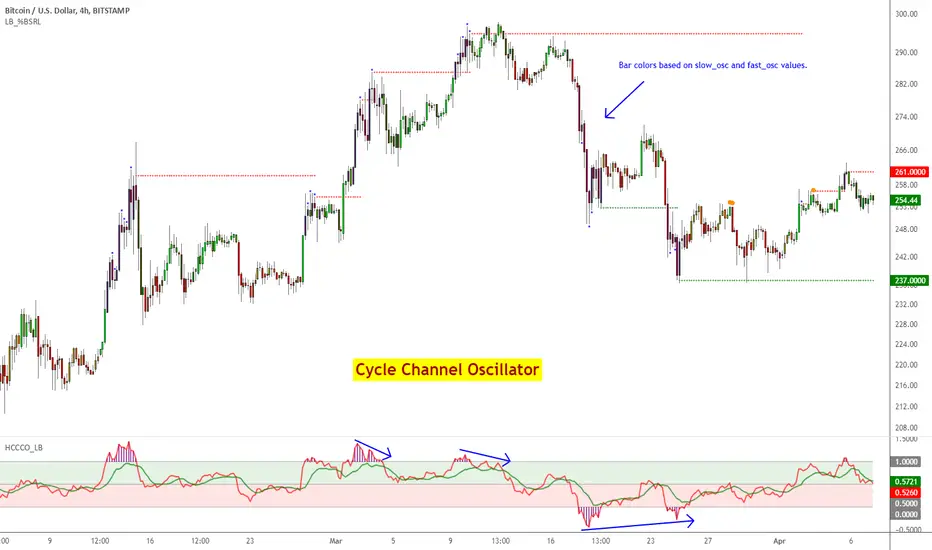
Cycle Channel Oscillator [LazyBear]Here's an oscillator derived from my previous script, Cycle Channel Clone ().
There are 2 oscillator plots - fast & slow. Fast plot shows the price location with in the medium term channel, while slow plot shows the location of short term midline of cycle channel with respect to medium term channel.
Usage of this is similar to %b oscillator. The slow plot can be considered as the signal line.
Bar colors can be enabled via options page. When short plot is above 1.0 or below 0, they are marked purple (both histo and the bar color) to highlight the extreme condition.
This makes use of the default 10/30 values of Cycle Channel, but may need tuning for your instrument.
More info:
List of my free indicators: bit.ly
List of my app-store indicators: blog.tradingview.com (More info: bit.ly)
Pine Script® インジケーター
Sakalau02 Yearly Monthly Sessions Sakalau02 Yearly Monthly Sessions is an advanced time-mapping tool designed to highlight monthly cycles throughout the year. The indicator converts raw price data into a clean visual structure, using arrays for optimized performance.
Macro Perspective: It allows you to visualize how price interacts with previous monthly highs and lows, making it ideal for identifying seasonal trends.
Array-Based Structure: Unlike traditional scripts, this dynamically handles data for all 12 months, ensuring low resource consumption even with a multi-year lookback.
Display Modes: Offers full flexibility by using Boxes (monthly price range), Zones (full-height background shading), or Timeline (discrete bottom markers).
Key Features:
Reference Levels: Includes the monthly Open price and the Equilibrium level (0.5 Level) for every session.
Individual Customization: Each month can be toggled and colored separately to highlight specific quarters or fiscal periods.
Alert System: Automated notifications for month starts and breakouts of monthly extremes (High/Low).
By Sakalau02 ( Andrei )
Pine Script® インジケーター
Monthly 14th Line (Past & Future)This utility indicator automatically draws a vertical line on a specific day of every month (default is the 14th). It is designed for traders who track monthly cycles, recurring economic events, or specific expiration dates.
Pine Script® インジケーター
Scientific MACD Scientific MACD v5.1 — User Guide
An advanced momentum oscillator featuring eight scientifically-modeled moving average algorithms with adaptive signal generation and real-time calculation stability.
Overview
This indicator reimagines the traditional MACD through the lens of multiple scientific disciplines. Rather than relying on simple exponential moving averages, it offers eight distinct mathematical frameworks for calculating trend components—each derived from physics, biology, information theory, or behavioral science. The result is a highly adaptive momentum system that adjusts its sensitivity to market conditions through dynamic error-tracking and hybrid ensemble methods.
Core Architecture
Three-Component Structure
Like the classic MACD, this indicator maintains three essential elements:
Fast Line: Short-term trend component (default: 12 periods)
Slow Line: Long-term trend component (default: 26 periods)
Signal Line: Smoothed derivative of the MACD line (default: 9 periods)
Independent Algorithm Selection
Each component can use any of the eight available moving average types independently. This allows sophisticated combinations such as Wave fast + Entropy slow + Synaptic signal, creating multi-domain confirmation systems.
Scientific Moving Average Models
1. Wave Mechanics MA
A Fourier-inspired bandpass filter that decomposes price into harmonic components. Uses multiple sine wave harmonics (fundamental + overtones) centered around a mean price, with amplitude derived from period range. Higher harmonics receive decreasing weights. Ideal for identifying cyclical price structures and filtering noise through frequency domain analysis.
2. Thermodynamic Entropy MA
Applies information theory concepts to market returns. Calculates Shannon entropy across a 5-bin probability distribution of returns, then uses entropy ratio to adapt smoothing intensity. High entropy (disorder) increases smoothing; low entropy (trending) decreases smoothing. Adds small entropy-based adjustments to center the moving average.
3. Biological Synaptic MA
Implements Hebbian learning rules from neural biology. Maintains adaptive weights for recent price history that strengthen when current price movements correlate with past movements (associative learning). Weights decay exponentially with time and normalize between 0.5 and 2.0. Excels at capturing momentum persistence and regime changes.
4. Quantum Uncertainty MA
Models price as a quantum superposition of states with probabilistic amplitudes. Uses Gaussian distance functions to project current price onto historical basis states, then calculates expectation values. Incorporates decoherence (mixing with previous states) for stability. Naturally handles uncertainty and provides smooth transitions between trend states.
5. Fluid Dynamics MA
Treats price movement as fluid flow with Reynolds number classification. Calculates characteristic velocity, viscosity, and Reynolds number to determine flow regime. Laminar flow (low Re) uses diffusion-dominated smoothing; turbulent flow (high Re) uses advection-dominated smoothing. Includes stability clamps to prevent extreme deviations.
6. Network Cascade MA
Applies epidemiological SIR (Susceptible-Infected-Recovered) models to price trends. Models trend strength as infection rate spreading through market participants. Adaptive smoothing based on active infections (trend strength) with mean reversion as recovery increases. Beta parameter derived from return surprises relative to volatility.
7. Behavioral Economics MA
Incorporates Prospect Theory from psychology. Maintains an adaptation level (reference point) that updates slowly. Applies Tversky-Kahneman value functions with loss aversion (lambda = 2.25) and diminishing sensitivity (alpha = 0.88). Weights prices by psychological value rather than linear distance, emphasizing gains/losses relative to perceived anchors.
8. Hybrid Ensemble MA
Combines all seven models through inverse-error weighting. Tracks exponential moving average of prediction errors for each component model, then assigns weights inversely proportional to recent error. Automatically favors whichever scientific model best fits current market conditions. Displays real-time weight distribution table when enabled.
Signal Generation
Quality-Filtered Crossovers
Standard MACD crossovers are enhanced with statistical quality gates:
Bull Signal: MACD crosses above Signal while MACD is below zero and histogram exceeds 80th percentile of recent values
Bear Signal: MACD crosses below Signal while MACD is above zero and histogram below 20th percentile of recent values
High-Quality Signals
Additional filter requiring signal quality ratio (histogram magnitude divided by histogram volatility) to exceed 2.0. These appear as HQ↑ and HQ↓ markers, indicating statistically significant momentum shifts.
Visualization Features
Dynamic Color Coding
MACD Line: Lime/olive when above signal (bullish), red/maroon when below (bearish)
Histogram: Intensity varies with signal quality—brighter colors indicate stronger statistical significance
Signal Line: Orange for clear differentiation
Zero Line: Dashed gray reference
Volatility Zone: Gray fill between ±1 standard deviation of MACD values
Hybrid Weight Display
When Hybrid MA is selected and Show Hybrid Weights is enabled, a real-time table displays current ensemble weightings for all seven component models as percentages. Updates dynamically as market conditions favor different scientific approaches.
Key Input Parameters
Core Settings
Fast Length: Short-term lookback (2-200, default 12)
Slow Length: Long-term lookback (3-500, default 26)
Signal Length: Smoothing period for signal line (2-100, default 9)
Scientific Parameters
ZigZag Detection Depth: Influences cyclicality measures in Wave and Fluid models (3-20, default 5)
Real-Time Calculation Fix: Blends calculated values with current price during unconfirmed bars to prevent repainting artifacts
MA Configuration
Independent algorithm selection for Fast, Slow, and Signal components. Options: Wave, Entropy, Synaptic, Quantum, Fluid, Cascade, Behavioral, Hybrid.
Display Settings
Toggle for Hybrid weight table visibility.
Operational Workflow
Select appropriate lengths for your timeframe and trading style
Choose MA algorithms based on market characteristics:
Trending markets: Synaptic, Cascade, or Behavioral
Cyclical/ranging markets: Wave or Quantum
High volatility: Entropy or Fluid
Unknown regime: Hybrid (adaptive ensemble)
Enable Real-Time Calculation Fix for live trading to prevent repainting
Monitor standard crossovers for entry signals
Prioritize HQ (High Quality) signals for lower-risk entries
Use histogram color intensity to gauge signal strength
When using Hybrid, monitor weight table to understand which models are currently dominant
Best Practices
Use longer lengths (20-50-10) for swing trading, standard (12-26-9) for day trading
Combine complementary algorithms: fast Wave + slow Entropy captures cycles within noise-filtered trends
Enable Hybrid during regime uncertainty—it automatically selects optimal models
Disable Real-Time Calculation Fix for historical analysis, enable for live signals
Watch for divergence between MACD and price while monitoring histogram quality for confirmation
Volatility zone fill helps identify when MACD moves reach statistical extremes
This indicator provides mathematically sophisticated trend analysis. Algorithm selection significantly impacts signal characteristics—experiment with combinations to find optimal fit for your market and timeframe.
Pine Script® インジケーター
Sakalau02 10 sessionsMarket Sessions: The Institutional Chronological Compass
The "Market Sessions - By Sakalau" indicator is a high-precision visualization tool designed to map the temporal structure of financial markets directly onto your chart. It acts as a chronological guide, helping traders identify volatility cycles and the institutional "changing of the guard" across global financial hubs.
Here is why this script is essential for your strategy:
🌐 Extensive Global Coverage
Unlike standard indicators that only track the "Big Three" (London, New York, Tokyo), this script by Sakalau supports up to 10 fully customizable sessions. This allows you to track specific liquidity pockets, such as the Frankfurt open, Hong Kong, or Mumbai.
📊 Visualizing Market Phases
The indicator uses a Box-based visual system to encapsulate price action within specific timeframes. This makes it easy to identify:
Accumulation Phases: Typically seen during low-volume sessions (Sydney/Asia) where price moves sideways in a tight range.
Expansion/Trend Phases: Identified when a new session (London/NY) breaks out of the previous session’s high or low.
Distribution/Reversals: Indicated when price reaches the boundaries of a session box and fails to sustain the move.
🧠 Advanced Technical Insights
The script does more than draw shapes; it extracts crucial data for execution:
Open/Close Lines: Highlights the session's starting price versus its current trajectory at a glance.
0.5 Median Level (Equilibrium): Automatically plots the midpoint of each session's range. In institutional trading, this is considered "Fair Value"—a magnet for price and a major support/resistance area.
Performance Management: The Lookback feature ensures your chart remains fast and responsive by limiting processing to a set number of days.
🎨 Customization & Clarity
Display Modes: Choose between Boxes, Zones (background highlights), or Timeline views.
Aesthetics: Total control over colors, opacity, and line styles (solid, dashed, dotted) for a premium visual experience.
P.S
Alții caută confirmări, eu desenez zonele ✍️. O unealtă creată pentru cei care înțeleg că în trading, CÂND tranzacționezi este la fel de important ca CE tranzacționezi — nu uitați să verificați 0.5-ul! — Semnat, Andrei (Sakalau02)🧭🎯⌛💎
Pine Script® インジケーター
Sakalau02 - 10 SessionsThis Pine Script indicator, "Market Sessions - 10 Sessions", is a professional-grade visualization tool designed to map the temporal structure of the financial markets directly onto your chart. It acts as a "chronological compass," helping traders identify volatility cycles and the institutional "changing of the guard" across global financial hubs.
Here is a breakdown of its core features and why it is ideal for highlighting market phases:
## Comprehensive Global Coverage
While most indicators only track the "Big Three" (London, New York, Tokyo), this script provides support for up to 10 customizable sessions.
Standard Sessions: Tokyo, London, New York, and Sydney.
Extended Hubs: Includes Frankfurt, Hong Kong, Singapore, Shanghai, Toronto, and Mumbai.
Why it matters: This allows you to track specific liquidity pockets, such as the Frankfurt open (which often front-runs London) or the crucial Asian-Pacific overlaps.
## Visualizing Market Phases
The indicator uses a Box-based visual system to encapsulate price action within specific timeframes. This helps in identifying:
Accumulation Phases: Typically seen during lower-volume sessions (like late Sydney or early Tokyo) where price moves sideways in a tight box.
Expansion/Trend Phases: Easily identified when a new session (like London or NY) breaks out of the previous session’s high or low.
Distribution/Reversals: Indicated when price reaches the upper or lower boundaries of a session box and fails to sustain the move.
## Key Technical Insights
The script doesn't just draw boxes; it provides "internal" session data to refine your entries:
Open/Close Lines: Highlights the session's starting price versus its current trajectory, helping you see if a session is "bullish" or "bearish" at a glance.
0.5 Median Level: Automatically plots the mid-point (50% level) of each session's range, which often acts as a significant "fair value" support or resistance area.
Pips & Percentage Tracking: Built-in hooks to calculate the volatility (range) of each session.
## Advanced Customization & Cleanliness
Overlap Management: Includes a "Merge Overlaps" feature to keep the chart clean during periods where multiple major markets are open simultaneously.
Lookback Control: To prevent chart lag, you can limit the history (e.g., last 150 days), ensuring the script runs smoothly even on lower timeframes.
Multi-Display Modes: Choose between Boxes, Zones (background highlights), or Timeline views depending on your preference for price action clarity.
## Summary for Trading Strategy
This indicator is perfect for Power of 3 (PO3) or ICT-style traders who rely on "Time and Price." By highlighting exactly when New York opens relative to London, or where the "London Lunch" stagnation occurs, it helps you avoid "choppy" low-liquidity periods and focus on high-probability volatility windows.
Alții caută confirmări, eu desenez zonele. ✍️ Sakalau02: Semnat, Andrei. (Nu uitați să verificați 0.5-ul!)
Pine Script® インジケーター
XAMD - cycles shows a table of active amd phases saves the trouble of having to look through htfs and you just see a table of them all
Pine Script® インジケーター
Hedge Fund Session Ranges [GMT+2] - Multi-Timezone TrackingOverview
This professional-grade tool is designed for institutional-style trading, specifically focusing on the Liquidity Cycles of the global markets. It allows traders to visualize key trading windows (Asia, Europe, and US) with precision, using a fixed GMT+2 offset—ideal for traders aligned with Middle Eastern or Eastern European timezones.
Key Features
Triple Session Tracking: Includes pre-defined windows for Asia, London Morning, and NY Afternoon.
Dynamic Box Scaling: Automatically calculates and visualizes the High/Low range of each session in real-time.
GMT+2 Optimization: Built-in timezone handling to ensure your charts align perfectly with local bank hours.
Clean Visuals: Minimalist design to avoid chart clutter, allowing for clear price action analysis.
Why Trade Sessions?
Institutional volume isn't distributed evenly throughout the day. By identifying the Asian Range (01:00-06:00), the London Open (10:00-12:00), and the NY Reversal/Trend (16:30-18:30), traders can identify "Liquidity Grabs" and "Expansion Phases" more effectively.
Pine Script® インジケーター
Neeson Mayer MultipleIntegrating the Mayer Multiple Indicator: A Practical Guide for Market Analysis
Introduction
The Mayer Multiple indicator is a specialized tool designed to assess asset valuations relative to their long-term historical trends. By comparing current price action against a long-term simple moving average, this indicator provides a quantitative framework for identifying potential overbought and oversold conditions. This article explains the rationale behind its design, operational mechanics, practical applications, and unique value proposition.
Purpose and Functionality
The primary function of the Mayer Multiple indicator is to measure how far current prices deviate from a long-term moving average, expressed as a ratio. This measurement helps traders and investors identify:
Extreme valuation levels that may signal potential reversal points
Long-term trend strength and sustainability
Market psychology shifts between fear and greed cycles
Originally popularized in Bitcoin analysis, the indicator's principles apply to any volatile asset class where mean reversion tendencies exist alongside strong trend characteristics.
Operational Principles
The indicator operates through several interconnected components:
Core Calculation Mechanism
At its heart, the indicator calculates the Mayer Multiple by dividing the current closing price by a configurable simple moving average (default: 200 periods). This ratio represents how many times the current price exceeds its long-term average, providing an immediate visual reference for valuation extremes.
Multi-Level Threshold System
Four configurable thresholds create distinct market condition zones:
Optimal Buy Zone (default: 0.7) - Historically extreme undervaluation
Undervalued Zone (default: 1.0) - Moderate undervaluation
Overvalued Zone (default: 2.4) - Moderate overvaluation
Optimal Sell Zone (default: 3.5) - Historically extreme overvaluation
These thresholds create a graduated scale of market conditions rather than binary signals.
Visual Signal Hierarchy
A sophisticated color-coding system prioritizes different signal types based on their significance:
White/Gray: Neutral territory (between undervalued and overvalued thresholds)
Aqua: Entering undervalued territory (potential accumulation zone)
White: Reaching optimal buying conditions (historically rare opportunities)
Yellow: Entering overvalued territory (potential distribution zone)
Orange: Reaching optimal selling conditions (historically rare extremes)
Green: Emerging from optimal buying conditions (momentum shift confirmation)
Red: Retreating from optimal selling conditions (momentum reversal confirmation)
This hierarchy helps users distinguish between entry signals, exit signals, and confirmation signals.
Integration Rationale
The integration of these components follows a logical progression:
Mathematical Foundation
The moving average provides a stable reference point that filters out short-term noise while maintaining sensitivity to long-term trend changes. The ratio format normalizes values across different price levels and timeframes, enabling cross-asset comparisons.
Behavioral Finance Alignment
The threshold system corresponds to documented market psychology patterns. The extreme thresholds (optimal buy/sell) represent points where fear or greed typically reach maximum intensity, while the moderate thresholds represent early warning levels.
Progressive Signal Detection
The indicator tracks both threshold breaches and retreats from extreme zones. This dual-tracking approach captures not only when conditions become extreme but also when they begin to normalize—often the most actionable moments for position adjustments.
Component Synergy
The indicator's components work together through a continuous feedback loop:
Calculation Engine: Continuously computes the core ratio, serving as the foundation for all subsequent analysis.
Threshold Comparator: Compares the current ratio against user-defined thresholds, categorizing market conditions in real-time.
Signal Generator: Identifies specific events (threshold crossings, zone entries/exits) and assigns appropriate visual representations.
Visual Renderer: Displays the information through colored histograms, reference lines, and data tables, creating an intuitive interface.
Alert System: Monitors for predefined conditions and notifies users of significant developments without requiring constant screen monitoring.
This integrated approach transforms raw price data into structured, actionable information while maintaining mathematical rigor and visual clarity.
Practical Application Guidelines
Parameter Customization
Users should adjust parameters based on:
Asset volatility (higher volatility assets may require wider thresholds)
Timeframe (longer timeframes may benefit from longer moving averages)
Personal risk tolerance (conservative traders may use tighter thresholds)
Signal Interpretation Framework
Zone-Based Analysis: Focus on which zone the indicator occupies rather than chasing individual data points
Confirmation Seeking: Use extreme zone signals (white/orange) as alerts for further analysis rather than automatic trade triggers
Momentum Assessment: Observe how quickly the indicator moves between zones as a measure of trend strength
Complementary Tools
The Mayer Multiple works best when combined with:
Volume analysis to confirm participation during extreme readings
Momentum indicators to identify potential divergence
Support/resistance levels for precise entry/exit timing
Fundamental analysis for context validation
Distinctive Attributes
Original Implementation Features
Progressive Color System: Unlike binary indicators, this implementation provides graduated signals through a carefully prioritized color hierarchy.
Dual-Signal Detection: The indicator captures both threshold breaches and retreats, offering insights into momentum shifts rather than just static levels.
Contextual Display: The integrated data table provides immediate access to key metrics without cluttering the chart space.
Customizable Framework: All thresholds and calculation periods are adjustable, allowing adaptation to different market regimes and trading styles.
Practical Innovation
The indicator's design emphasizes usability through:
Immediate visual comprehension via color coding
Clear separation between alert conditions and confirmation signals
Balanced information density (sufficient data without overload)
Flexible integration with existing trading workflows
Responsible Usage Considerations
Empirical Perspective
Historical analysis suggests that assets frequently revert toward their long-term moving averages, but the timing and extent of such reversions vary significantly. The indicator identifies statistical extremes rather than predicting immediate price movements.
Risk Management Integration
Users should:
Treat extreme readings as risk management triggers rather than directional forecasts
Consider position sizing based on distance from the moving average
Implement stop-loss strategies regardless of indicator readings
Avoid allocating excessive weight to any single indicator
Performance Realism
The indicator does not guarantee profitable outcomes. Its value lies in providing structured information about valuation extremes, which must be interpreted within broader market context and individual risk parameters.
Conclusion
The Mayer Multiple indicator represents a thoughtfully integrated approach to long-term valuation analysis. By combining mathematical rigor with behavioral insights and practical visualization, it provides traders with a structured framework for assessing market extremes. Its modular design allows customization while maintaining core analytical integrity, and its emphasis on graduated signals helps avoid the oversimplification common in technical indicators. When used as part of a comprehensive trading methodology with appropriate risk management, it can contribute valuable perspective to the decision-making process.
Pine Script® インジケーター