OPEN-SOURCE SCRIPT
Kaufman's Adaptive Moving Average (KAMA)
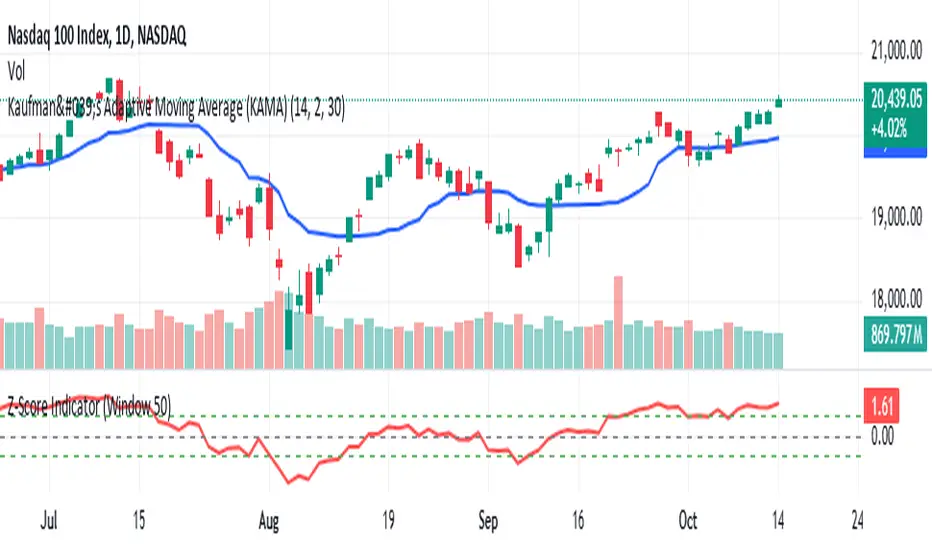
Another simple easy to use indicator that incorporates mean reversion and trend following.
Kaufman's Adaptive Moving Average (KAMA) is an indicator developed by Perry Kaufman that adjusts its sensitivity based on market volatility. It is designed to react more quickly during trending markets and slow down in sideways or volatile markets. The primary idea is that in a trending market, the moving average should be more sensitive to price changes, while in a non-trending market, it should be less responsive to noise.
KAMA Formula
The formula for the Kaufman Adaptive Moving Average is:
Efficiency Ratio (ER): Measures the efficiency of price movement over a given period.
ER
=
Smoothing Factor
Volatility
=
Sum of absolute price change
Sum of absolute price movement
ER=
Volatility
Smoothing Factor
=
Sum of absolute price movement
Sum of absolute price change
The Efficiency Ratio is calculated by taking the price change over a defined period and dividing it by the total price movement (which is the sum of absolute price changes).
Smoothing Constant (SC): This is a factor used to adjust the moving average's responsiveness:
SC
=
ER
×
(
2
/
(
𝑛
+
1
)
)
+
(
1
−
ER
)
×
(
2
/
(
𝑛
+
1
)
)
SC=ER×(2/(n+1))+(1−ER)×(2/(n+1))
where n is the length of the moving average period.
Steps to Calculate KAMA:
Efficiency Ratio (ER):
Calculate the sum of absolute price changes over the chosen period.
Calculate the sum of absolute price movements over the same period.
Smoothing Constant (SC):
Use the Efficiency Ratio to adjust the smoothing factor.
KAMA Calculation:
The initial KAMA is the simple moving average (SMA) of the first n periods.
For subsequent periods, KAMA is calculated using a formula based on the smoothing constant and previous KAMA values.
experiment with the variables as you like!!
Kaufman's Adaptive Moving Average (KAMA) is an indicator developed by Perry Kaufman that adjusts its sensitivity based on market volatility. It is designed to react more quickly during trending markets and slow down in sideways or volatile markets. The primary idea is that in a trending market, the moving average should be more sensitive to price changes, while in a non-trending market, it should be less responsive to noise.
KAMA Formula
The formula for the Kaufman Adaptive Moving Average is:
Efficiency Ratio (ER): Measures the efficiency of price movement over a given period.
ER
=
Smoothing Factor
Volatility
=
Sum of absolute price change
Sum of absolute price movement
ER=
Volatility
Smoothing Factor
=
Sum of absolute price movement
Sum of absolute price change
The Efficiency Ratio is calculated by taking the price change over a defined period and dividing it by the total price movement (which is the sum of absolute price changes).
Smoothing Constant (SC): This is a factor used to adjust the moving average's responsiveness:
SC
=
ER
×
(
2
/
(
𝑛
+
1
)
)
+
(
1
−
ER
)
×
(
2
/
(
𝑛
+
1
)
)
SC=ER×(2/(n+1))+(1−ER)×(2/(n+1))
where n is the length of the moving average period.
Steps to Calculate KAMA:
Efficiency Ratio (ER):
Calculate the sum of absolute price changes over the chosen period.
Calculate the sum of absolute price movements over the same period.
Smoothing Constant (SC):
Use the Efficiency Ratio to adjust the smoothing factor.
KAMA Calculation:
The initial KAMA is the simple moving average (SMA) of the first n periods.
For subsequent periods, KAMA is calculated using a formula based on the smoothing constant and previous KAMA values.
experiment with the variables as you like!!
オープンソーススクリプト
TradingViewの精神に則り、このスクリプトの作者はコードをオープンソースとして公開してくれました。トレーダーが内容を確認・検証できるようにという配慮です。作者に拍手を送りましょう!無料で利用できますが、コードの再公開はハウスルールに従う必要があります。

免責事項
この情報および投稿は、TradingViewが提供または推奨する金融、投資、トレード、その他のアドバイスや推奨を意図するものではなく、それらを構成するものでもありません。詳細は利用規約をご覧ください。
オープンソーススクリプト
TradingViewの精神に則り、このスクリプトの作者はコードをオープンソースとして公開してくれました。トレーダーが内容を確認・検証できるようにという配慮です。作者に拍手を送りましょう!無料で利用できますが、コードの再公開はハウスルールに従う必要があります。
免責事項
この情報および投稿は、TradingViewが提供または推奨する金融、投資、トレード、その他のアドバイスや推奨を意図するものではなく、それらを構成するものでもありません。詳細は利用規約をご覧ください。