
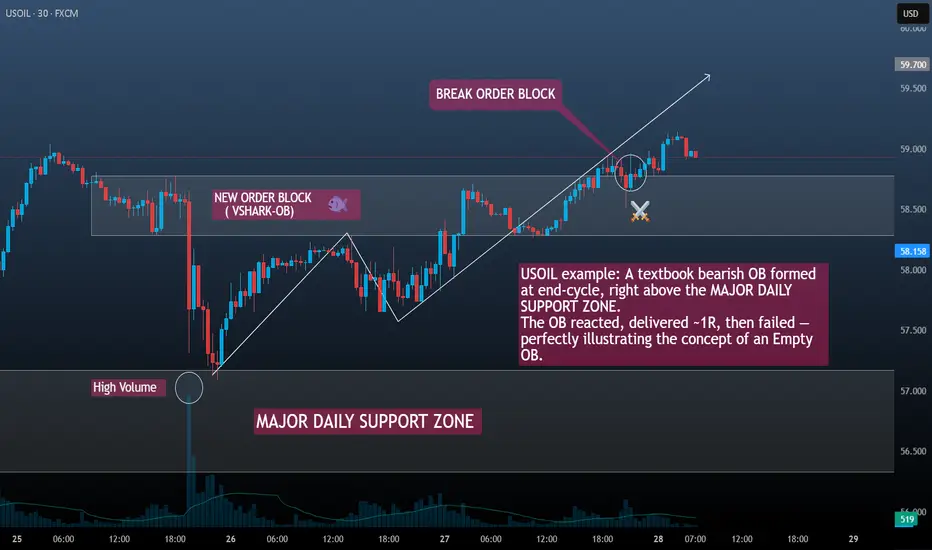
Order Blocks are powerful tools — but they are not sacred zones where we can place absolute confidence.
Even a perfect-looking OB can fail if traders ignore context and its position within the market structure.
A strong displacement, a clean IMB, a clear structure break — these make an OB look perfect on the surface.
But the deeper question is:
👉 Where did this OB form in the overall market cycle?
1️⃣ End-Cycle OBs Look Strong but Carry No Real Strength
Toward the end of a strong trend:
The market runs out of opposing liquidity
Retail traders FOMO into the direction
Counterflow dries up
Buy-side or sell-side participation becomes extremely weak
Without matching orders, Big Money simply cannot push the trend further, even if they generate a strong displacement candle.
This creates the classic “Empty OB”:
Beautiful structure
Strong Phase 1 push
But no institutional follow-through
No Phase 2 continuation
Easy to break with minimal volume
In other words:
👉 Perfect OB, zero internal strength.
2️⃣ Why Big Money Creates a Perfect OB but Doesn’t Continue the Move
A common misunderstanding is believing that a beautiful OB = strong OB.
In reality, at the end of a cycle, institutions often:
Push price with a strong Phase 1 move
Sweep liquidity
Trigger retail entries
Complete their short-term objective
…but when price approaches major HTF support or resistance, they:
👉 Cancel their pending orders
👉 Avoid Phase 2 continuation
👉 Stop committing further capital
The OB remains on the chart — but only as liquidity history, not as active institutional interest.
This is why many “textbook” OBs fail instantly.
3️⃣ Empty OBs Break Easily Near HTF Zones
When price reaches strong H4 or D1 support/resistance:
Retail Buy/Sell activity increases
Institutions stay neutral
Price rises or falls slowly with low volume
And eventually breaks the OB effortlessly
This creates the classic behavior:
👉 Low volume, big impact — Empty OB collapse.
This is exactly what happened to USOIL:
Beautiful bearish OB
Strong displacement
Clean IMB
Nice reaction and even delivered ~1R
But HTF support absorbed the move
Institutions did not push Phase 2
OB failed with small pullback volume
Logical. Clean. And completely in line with end-cycle mechanics.
4️⃣ A Failed OB at End-Cycle Is Not a Bad Sign — It’s a Signal
Most retail traders panic when a perfect OB fails.
Professionals don’t.
Because an OB failing at end-cycle often indicates:
The prior trend is exhausted
Liquidity has been redistributed
HTF structure is taking control
A new cycle is forming
Better opportunities will appear right after the OB breaks
Sometimes, waiting for the OB to fail gives a much clearer, safer, and stronger setup than trading the OB itself.
Conclusion
Order Blocks are powerful —
but they only work when they’re backed by true institutional flow and placed correctly within the market cycle.
When an OB forms:
At the end of a trend
Near HTF support/resistance
When liquidity is dried up
When Phase 2 is absent
…it becomes an Empty OB: beautiful on the surface, but extremely fragile.
The failure of such an OB is not noise.
It is information — a message from Big Money that a new phase is coming.
First Comment (for posting)
Even perfect OBs can fail — especially at end-cycle.
Yesterday’s USOIL setup illustrated this perfectly.
Share your thoughts: Do you track “Empty OBs” in your analysis?
Signature
— VNShark
Institutional OB • Liquidity • Volume • Market Structure
Tag:
#OrderBlock, #SmartMoneyConcept, #SmartMoney, #Liquidity, #VolumeAnalysis, #Imbalance, #MarketStructure, #OBTrading, #InstitutionalTrading, #PriceAction, #BigMoney, #VNSharkOB, #USOIL, #CrudeOil, #WTI, #TradingEducation, #ForexTrading, #CommodityTrading, #TrendAnalysis
Even a perfect-looking OB can fail if traders ignore context and its position within the market structure.
A strong displacement, a clean IMB, a clear structure break — these make an OB look perfect on the surface.
But the deeper question is:
👉 Where did this OB form in the overall market cycle?
1️⃣ End-Cycle OBs Look Strong but Carry No Real Strength
Toward the end of a strong trend:
The market runs out of opposing liquidity
Retail traders FOMO into the direction
Counterflow dries up
Buy-side or sell-side participation becomes extremely weak
Without matching orders, Big Money simply cannot push the trend further, even if they generate a strong displacement candle.
This creates the classic “Empty OB”:
Beautiful structure
Strong Phase 1 push
But no institutional follow-through
No Phase 2 continuation
Easy to break with minimal volume
In other words:
👉 Perfect OB, zero internal strength.
2️⃣ Why Big Money Creates a Perfect OB but Doesn’t Continue the Move
A common misunderstanding is believing that a beautiful OB = strong OB.
In reality, at the end of a cycle, institutions often:
Push price with a strong Phase 1 move
Sweep liquidity
Trigger retail entries
Complete their short-term objective
…but when price approaches major HTF support or resistance, they:
👉 Cancel their pending orders
👉 Avoid Phase 2 continuation
👉 Stop committing further capital
The OB remains on the chart — but only as liquidity history, not as active institutional interest.
This is why many “textbook” OBs fail instantly.
3️⃣ Empty OBs Break Easily Near HTF Zones
When price reaches strong H4 or D1 support/resistance:
Retail Buy/Sell activity increases
Institutions stay neutral
Price rises or falls slowly with low volume
And eventually breaks the OB effortlessly
This creates the classic behavior:
👉 Low volume, big impact — Empty OB collapse.
This is exactly what happened to USOIL:
Beautiful bearish OB
Strong displacement
Clean IMB
Nice reaction and even delivered ~1R
But HTF support absorbed the move
Institutions did not push Phase 2
OB failed with small pullback volume
Logical. Clean. And completely in line with end-cycle mechanics.
4️⃣ A Failed OB at End-Cycle Is Not a Bad Sign — It’s a Signal
Most retail traders panic when a perfect OB fails.
Professionals don’t.
Because an OB failing at end-cycle often indicates:
The prior trend is exhausted
Liquidity has been redistributed
HTF structure is taking control
A new cycle is forming
Better opportunities will appear right after the OB breaks
Sometimes, waiting for the OB to fail gives a much clearer, safer, and stronger setup than trading the OB itself.
Conclusion
Order Blocks are powerful —
but they only work when they’re backed by true institutional flow and placed correctly within the market cycle.
When an OB forms:
At the end of a trend
Near HTF support/resistance
When liquidity is dried up
When Phase 2 is absent
…it becomes an Empty OB: beautiful on the surface, but extremely fragile.
The failure of such an OB is not noise.
It is information — a message from Big Money that a new phase is coming.
First Comment (for posting)
Even perfect OBs can fail — especially at end-cycle.
Yesterday’s USOIL setup illustrated this perfectly.
Share your thoughts: Do you track “Empty OBs” in your analysis?
Signature
— VNShark
Institutional OB • Liquidity • Volume • Market Structure
Tag:
#OrderBlock, #SmartMoneyConcept, #SmartMoney, #Liquidity, #VolumeAnalysis, #Imbalance, #MarketStructure, #OBTrading, #InstitutionalTrading, #PriceAction, #BigMoney, #VNSharkOB, #USOIL, #CrudeOil, #WTI, #TradingEducation, #ForexTrading, #CommodityTrading, #TrendAnalysis

関連の投稿
免責事項
この情報および投稿は、TradingViewが提供または推奨する金融、投資、トレード、その他のアドバイスや推奨を意図するものではなく、それらを構成するものでもありません。詳細は利用規約をご覧ください。
免責事項
この情報および投稿は、TradingViewが提供または推奨する金融、投資、トレード、その他のアドバイスや推奨を意図するものではなく、それらを構成するものでもありません。詳細は利用規約をご覧ください。